Bottom brackets: when to service, when to replace

•9 min read
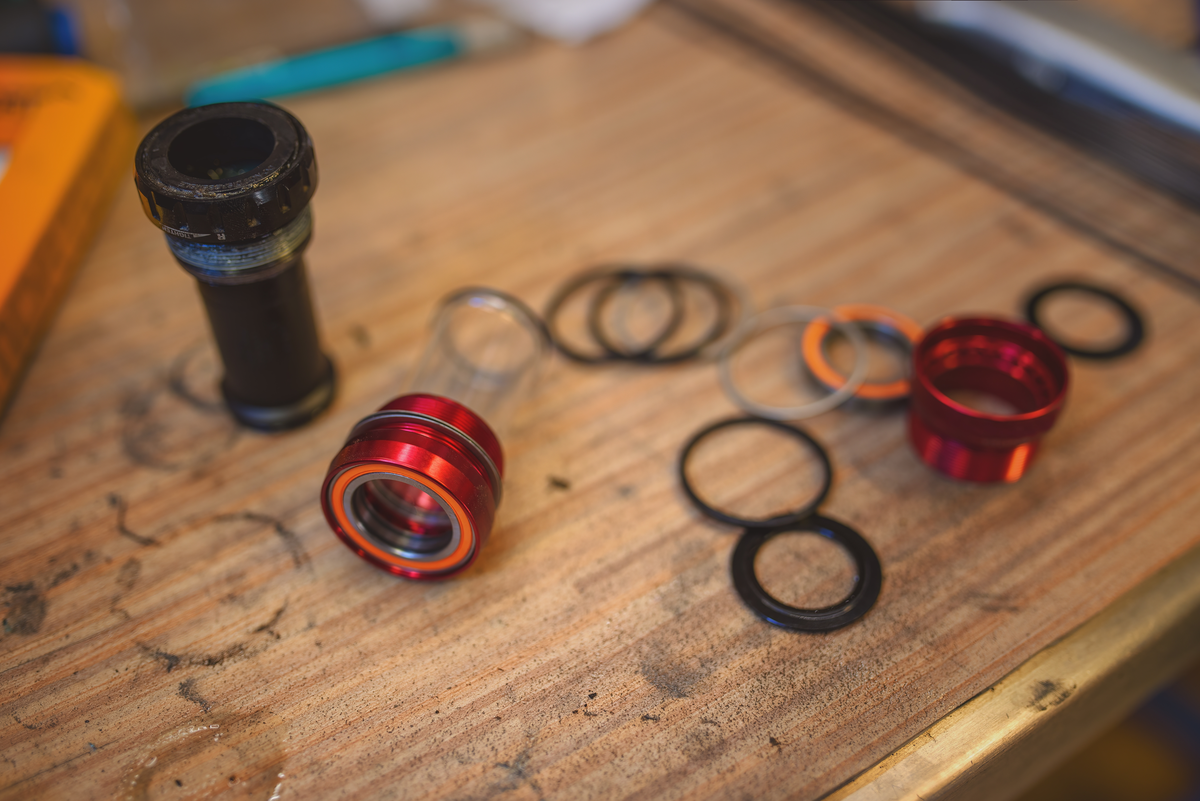
Quick answer: Service first, replace only when the bearings are gone. Pull the cranks and spin them by hand with the chain off: smooth and quiet means the interface just needs cleaning and fresh grease (€0, 15 minutes). Crunchy, gritty, or notchy means the bearings are worn — replace the cartridge (€30–80). For most modern cartridge BBs there's no third option; they're consumables, not serviceable.
You diagnosed the creak. It's the bottom bracket. Now what?
For most riders, the next ten minutes go one of two ways. Either you pull the cranks, regrease the interface, retorque to spec, and the noise vanishes — €0 spent, fifteen minutes gone, problem solved. Or you do exactly the same thing, ride 50 km, and the creak comes back, except now you've also realized the bearings feel rumbly when you spin the cranks by hand. That's a different problem with a different cost.
The decision isn't actually "service or replace" — it's a sequence of three smaller decisions, and the order matters.
The three decisions, in order
- Is the interface dirty/dry, or are the bearings worn? The fix is completely different.
- If bearings are worn — is your BB serviceable, or do you replace the whole cartridge? Modern cartridge BBs are usually one-shot consumables.
- If you're replacing — is the frame's BB shell the actual problem? Press-fit shells with manufacturing tolerance issues will creak with any cartridge you put in.
We'll work through each.
Decision 1 — interface or bearings?
The first test takes 30 seconds and decides whether you spend €0 or €60.
| Test | Result | Diagnosis |
|---|---|---|
| Rock the cranks side-to-side, hard | Any perceptible play | Either crank pinch bolts loose OR BB shot — go further |
| Spin the cranks by hand with the chain off | Smooth, quiet, glides | Interface is dry/dirty. Pull cranks, regrease, retorque. |
| Spin the cranks by hand with the chain off | Crunchy, rough, gritty feel | Bearings are worn. Replace the cartridge. |
| Spin the cranks by hand with the chain off | Notchy or seized in spots | Bearings dead. Replace, and check if water has entered the shell. |
If the cranks spin smoothly by hand but the bike still creaks under pedaling, the bearings are not the problem. The fix is at the crank-arm-to-spindle interface, the chainring bolts, or the BB cup-to-frame interface. Pull the cranks, clean the spindle and the cup, apply fresh grease (or anti-seize for steel-on-steel threads), retorque to spec.
This fixes 60–70% of "BB creaks" without replacing anything.
What this looked like on my own bike
My Cannondale Scalpel gave me the top row of that table: a small but unmistakable play in the cranks — rock them side-to-side and you could feel the movement. Bearings worn, not an interface problem. So the crank came off to replace the BB30 bearings.
Then the job got fiddlier than I expected. I reached for the Park Tool BBT-30.4 I normally use to pull BB30 bearings, and it had nothing to grab: this frame seats the bearings behind a fixed retainer, not the removable circlips I was expecting — and Park Tool note the BBT-30.4 won't work where an inner sleeve or retainer blocks the bearing. So I switched to the Park Tool RT-1 cup remover — the tap-it-through-with-a-mallet tool meant for headset and press-fit cups — and drove the bearings out from the far side. It works, but it's blunter and less precise than the proper puller, so if your frame holds its bearings the same way, budget extra patience.
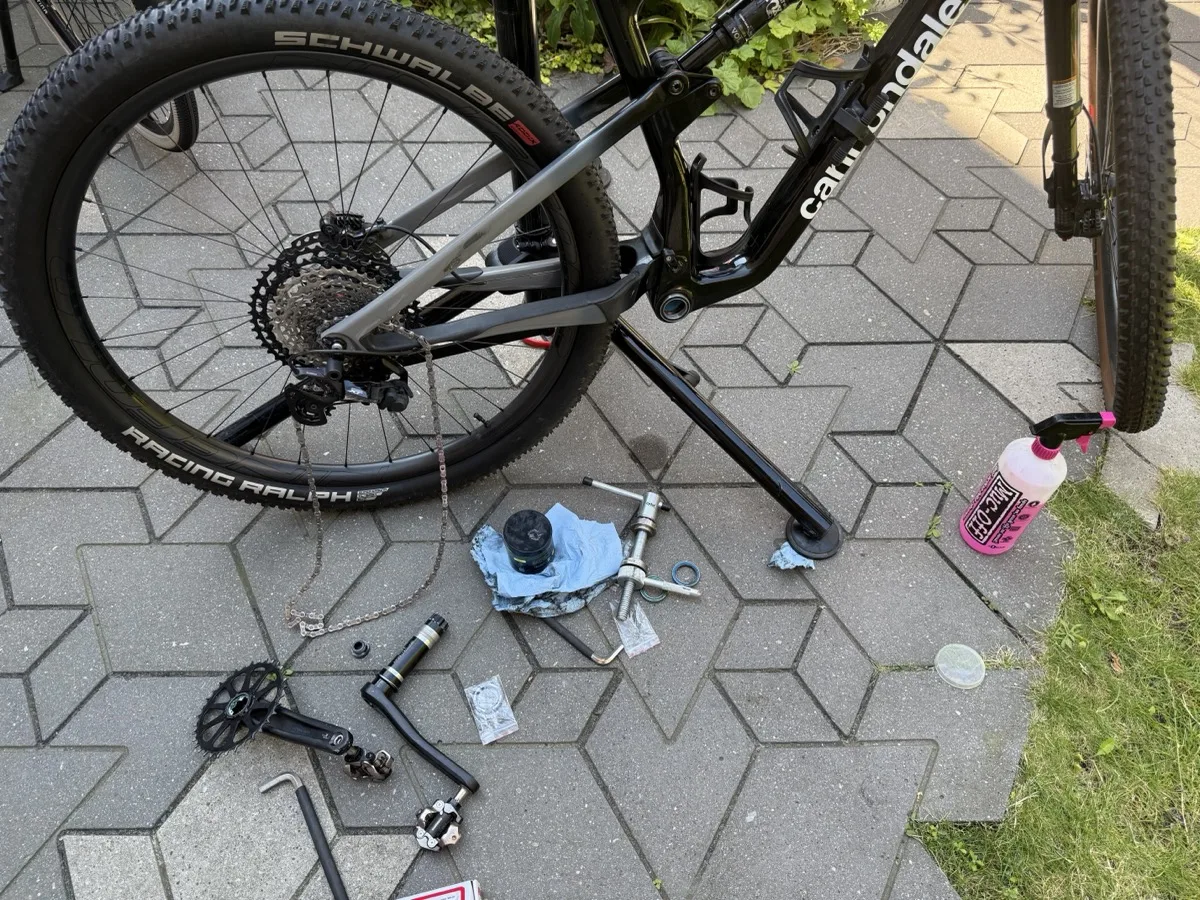
Mid-swap: crank out, old bearing and the RT-1 on the ground, new BB30 bearing still bagged.
Decision 2 — service the cartridge, or replace it?
If decision 1 told you the bearings are worn, the next question is whether your BB is serviceable.
The honest answer for most modern bikes: it isn't.
Cartridge BBs are sealed units. The bearings press into cups, both of which are designed as a single consumable. With very few exceptions, you replace the whole cartridge — pulling individual bearings out of a Shimano BB-RS500 and pressing in fresh ones is technically possible but costs more in tools and time than the new €25 cartridge.
The exceptions worth knowing:
- Premium serviceable BBs — Chris King, Phil Wood, Hope, White Industries. Rebearing kits exist (often €40–€60 vs. €150–€200 for a new BB). Service makes financial sense.
- Square-taper cup-and-cone (older bikes, simple commuters). Fully serviceable; loose ball bearings, individual cups, the works. If you're on one, you already know.
- Some Hambini / Wheels Manufacturing variants with replaceable bearings.
For everything else — Shimano BB-RS500 / RS501 / SM-BBR60 / Hollowtech II, SRAM DUB / GXP, Race Face Cinch, FSA MegaExo — the cost of service tools (bearing puller, press, race remover) exceeds the cartridge cost on the first job. Just replace.
"Cartridge bottom brackets are not serviceable, and given the cost of a new replacement cartridge, it's hard to make the case for servicing an old cartridge."
— Bicycle Parts Direct
Decision 3 — replacing the BB doesn't fix a bad shell
This is the one most riders miss. If the frame's BB shell has manufacturing-tolerance problems, a fresh cartridge will creak just as loudly within 500 km.
The BB shell can be the actual culprit on press-fit frames. From BikeRadar:
"Creaking bottom brackets are fundamentally the result of bike manufacturers reducing their costs to the absolute minimum and neglecting some geometric locating features during the manufacture of their frames, with finished products rarely having round holes that are aligned with each other."
If you're on a third cartridge in 18 months and it keeps creaking, the bearings aren't the issue. Two real fixes:
- BB conversion to threaded (T47, BB-to-BSA adapters). T47 specifically was designed to give press-fit's stiffness with threaded's reliability. Cost: €100–€200 for the conversion BB, plus possibly some frame prep at a shop.
- Wheels Manufacturing thread-together (also called "thread-fit"). Two cups thread into each other through the shell, locking solid. Doesn't rely on the shell's interference fit at all. Often the right answer for a chronically creaky press-fit.
The standards, briefly (so you order the right part)
You don't need to memorise every BB standard, but you do need to identify yours before you click "buy".
| Standard | Type | Shell width | Spindle | Common on |
|---|---|---|---|---|
| BSA / English | Threaded | 68 / 73 mm | 24 mm | Most road bikes pre-2015, many MTBs |
| T47 | Threaded | 68 / 77 / 86 / 100 mm | 24 / 30 mm | Modern road, gravel, premium frames (post-2018) |
| BB86 / BB92 | Press-fit | 86.5 / 91.5 mm | 24 mm | Shimano-leaning road and MTB |
| PF30 | Press-fit | 68 / 73 mm | 30 mm | Many mid-2010s road and gravel |
| BB30 | Press-fit (bearings direct) | 68 / 73 mm | 30 mm | Older Cannondale, etc. |
| BB386EVO / BBRight | Press-fit, oversized | 86 / 79 mm | 30 mm | Some race bikes |
| DUB | Threaded or press-fit | various | 28.99 mm | SRAM 12-speed |
Rule of thumb: if your bike is on a press-fit standard and it's chronically creaky, the conversion to T47 or thread-together is the long-term fix, not the third cartridge.
Two ways to identify yours: (1) read the frame manual or manufacturer's spec sheet, or (2) measure the shell width with a caliper and the inner diameter, and cross-reference Park Tool's identification guide.
Service intervals worth tracking
There's no universal number, but real-world data converges on roughly:
- Road, mostly dry, well-maintained: 10,000–15,000 km per cartridge.
- Gravel: 5,000–10,000 km.
- MTB, mixed conditions: 3,000–8,000 km.
- Wet / coastal / salt-treated roads: half the above. Water + grit kills BB bearings faster than anything else.
- E-bike: roughly two-thirds of acoustic-bike numbers — higher torque, often heavier riding.
Track the install distance on your BB component and you'll have data, not vibes, when the next creak shows up.
The maintenance routine
If you take nothing else from this post:
- Diagnose the interface vs. the bearings first. Spin the cranks by hand with the chain off. Smooth = interface fix. Crunchy = bearings.
- For interface fixes: clean both surfaces, fresh grease (or carbon paste if specified), retorque to manufacturer spec. Clears 60–70% of "BB creaks".
- For dead bearings: replace the whole cartridge unless you're on a Chris King / Phil / Hope. The math doesn't work otherwise.
- For chronic creaks despite fresh cartridges: the shell is the problem. Convert to threaded (T47 or thread-together) and stop fighting tolerances.
- Order the right standard. Read the frame spec or measure with calipers — there are eight active standards and they're not interchangeable.
Track it in WatchMy.bike
A bottom bracket should live as its own component on your bike. Add it once, log the install date and bike-distance-at-install, and:
- The chat can tell you "this BB has 7,400 km on it" when you ask "is my BB due?"
- Add a service interval at 10,000 km (road) / 5,000 km (gravel) / 3,000 km (MTB) so the system flags it before the creak does.
- When you regrease the interface (which is not a bearing replacement), log it as a service entry. If you find yourself regreasing the same BB three times in six months, the data tells you it's time for a new cartridge — or a shell conversation with the LBS.
- Open /chat and just say "add a Shimano SM-BBR60 to my Domane installed today at 8,200 km, 10,000 km service interval". The assistant creates the component and configures the alert in one call.
The pattern across the maintenance posts is the same: data beats memory. A creak you've heard before is a problem you've already solved — if you logged it.
Stuck on a press-fit creak that won't quit? Email me at marien@watchmy.bike — chronic-creak case studies make for the best follow-up posts.