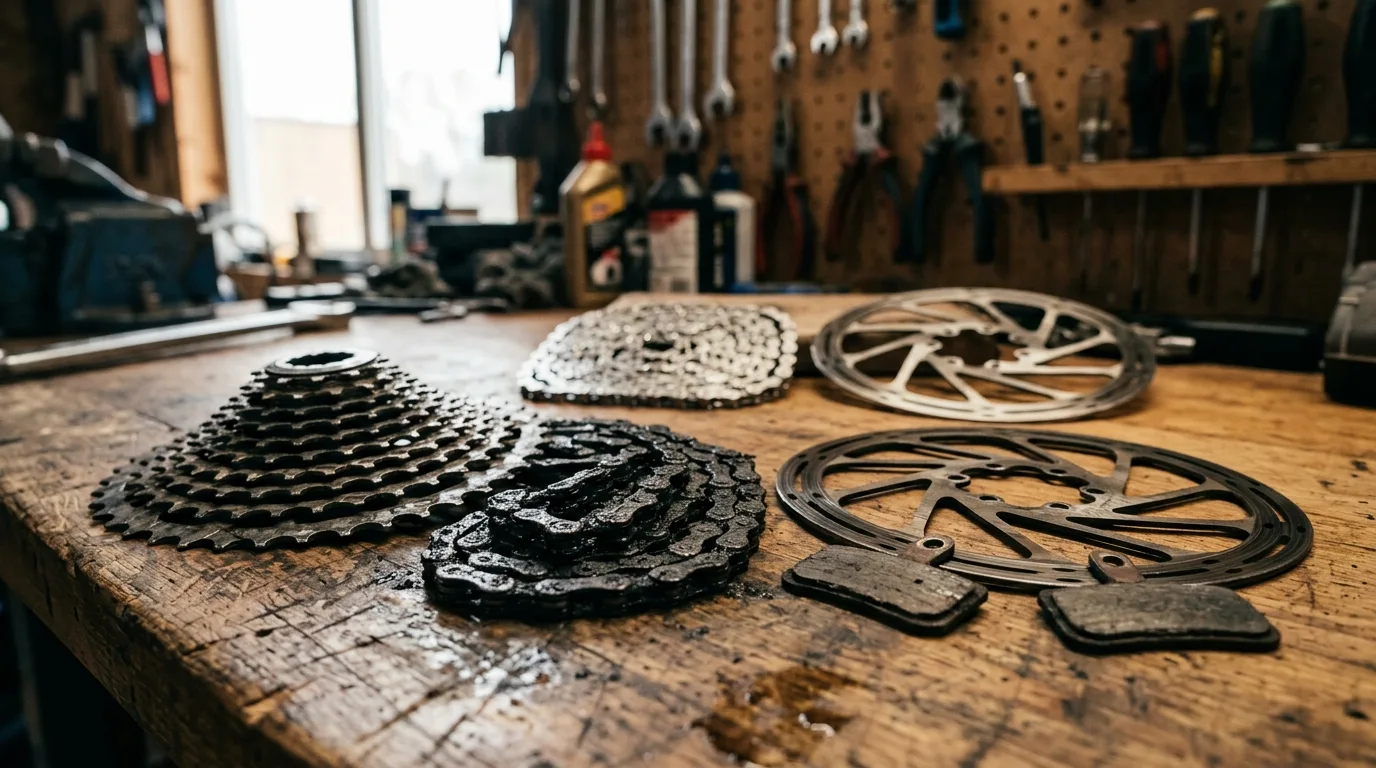
Cassette and Chainrings: When the Chain Forces You to Replace Them Too

•8 min read
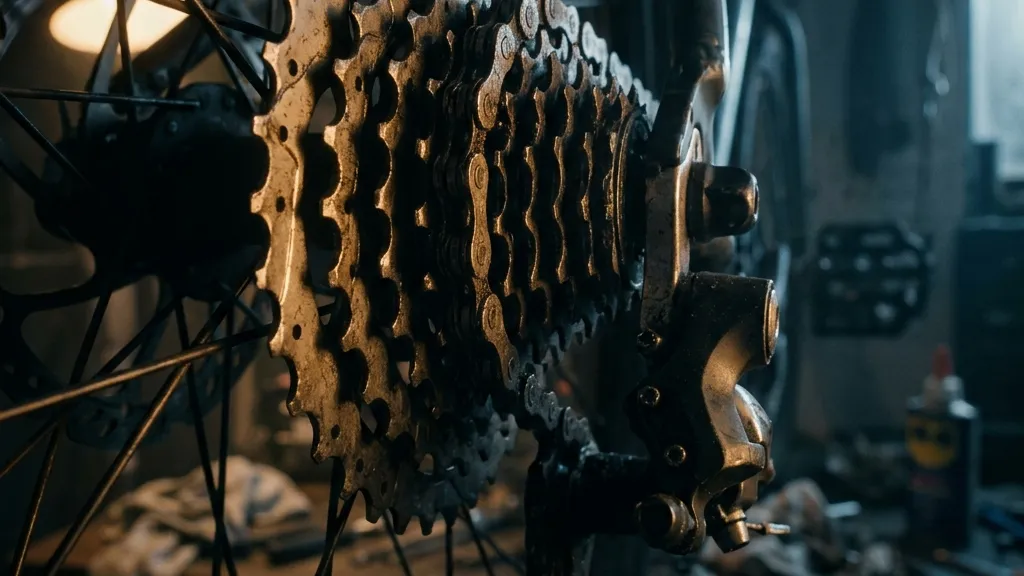
Quick answer: A cassette outlasts 2–4 chains — but only if every chain is replaced at 0.5% wear. To test whether a cassette is still good after fitting a new chain: ride 5–10 km then stand on the pedals in the cog you spend most time in. Skipping or jumping = cassette is dead, replace both. Chainrings outlast cassettes 2–3× again; check for shark-fin teeth and replace when the chain falls off under load.
You finally got around to swapping the chain. Took fifteen minutes, cost about €30, felt good. First proper ride, you stand on the pedals to roll up a small rise — and the chain jumps. Once. Twice. Halfway through the cassette there's a single cog that won't hold the chain under load.
That's a worn cassette telling you the chain you just replaced got swapped too late. The new chain doesn't fit the stretched tooth pitch on the cog you've spent the last 6,000 km in. Now you're replacing the cassette anyway, and the €30 chain just became a €120 service.
The good news: this is avoidable. The bad news: most riders discover it the way you just did.
The question this post answers
Do you have to replace the chain and cassette together? Or can the cassette outlive multiple chains?
The honest answer: the cassette can absolutely outlast 2 to 4 chains — but only if you replace each chain on time. Once a chain wears past its threshold, it reshapes the cassette teeth to match its stretched pitch. After that, a new chain on the old cassette skips under load.
Catch the chain early and the cassette lasts ~10,000 km. Catch it late and you're shopping for both.
The thresholds, by drivetrain
Park Tool publishes the canonical wear thresholds:
| Drivetrain | Replace chain at | Why |
|---|---|---|
| Single-speed | 1.0 % | Tougher steel, no shifting precision needed |
| 10-speed and below | 0.75 % | Wider chain, more tolerant of pitch error |
| 11-speed | 0.5 % | Tight tolerances, narrower chain |
| 12-speed (incl. SRAM AXS) | 0.5 % | Same — and often premium cogs |
The 0.5 % threshold on modern 11- and 12-speed isn't a recommendation — it's the line between "swap chain only" and "swap chain and cassette". A €15 chain checker (Park Tool's CC-3.2 or CC-4.2) reads this directly. It's the single best return-on-investment tool for any drivetrain that costs more than €200 to replace.
"Using a chain beyond its intended wear limit will prematurely wear out your cogs and chainrings." — Park Tool
"You should be able to swap chains two or three times without having to swap the cassette." — Glen Whittington, mechanic, Cycling Weekly
The lifecycle math
Stay disciplined and the numbers work out roughly like this:
- Chain lasts 3,000–5,000 km on a road bike in mostly dry conditions. Wet, gritty, salty riding pulls that down to 2,000–3,000 km.
- Cassette lasts 3 to 4 chains before the small cogs (the ones you actually pedal in) wear enough to skip a new chain.
- Total cassette lifespan: ~10,000 km road, less for MTB and e-bike (high torque + dirt).
- Chainrings: typically 2 to 4 cassettes — they distribute load across far more teeth and rarely lead the wear story.
A €15 chain checker, three €25 chains, and you stretch a €100+ cassette across 10,000 km of riding. Skip the checker, run one chain too long, and the cassette tags out at 5,000–6,000 km with both replaced together.
The €15 tool pays for itself in one cycle.
The skip test: how to know for certain
Visually checking a cassette for shark-fin teeth is unreliable. The wear is hard to see until it's far past the point of service, and the cog you can see best (the largest) isn't usually the one that wears out first — it's the small cogs in the middle of the cluster you actually ride in.
The reliable test is mechanical. After installing a new chain:
- Put the bike in a workstand or take it for a test ride.
- Shift to the cog you spend the most time in (often 14T or 15T on a road bike).
- Pedal hard — really hard. Stand up, simulate a sprint, push ~500 W if you can.
- Watch and feel. If the chain skips, jumps a tooth, or makes the lever twitch under load, that cog is done — and so is the cassette.
Repeat on the next two or three small cogs. If any of them skip, replace the cassette. If everything holds firm, you've saved €60–€150.
"Changes in tooth shapes and skipping under load are signs that your cassette needs replacing." — SRAM technical, via road.cc
Cassette-checking gauges exist, but mechanics generally consider them subjective compared to the skip test.
Why premium 12-speed is less forgiving
Modern high-end cassettes mix materials to save weight: alloy spider, titanium large cogs, hardened steel only on the smallest ones. Examples: Shimano Dura-Ace R9200, SRAM Red AXS XG-1290.
Those exotic cogs are softer than the steel chain. A worn chain with elongated pitch chews them disproportionately fast — a Dura-Ace cassette can be wrecked in a single 500 km miss-the-threshold ride. The same wear cycle on a Shimano 105 / SRAM Force cassette (mostly steel) would barely register.
If you ride premium 12-speed, treat 0.5 % chain wear as a non-negotiable hard limit, not a guideline.
Chainrings: when they enter the conversation
In a normal lifecycle, chainrings outlast the cassette by a factor of 2 to 4. But they do eventually wear, and the signs are different.
| Sign | What it means |
|---|---|
| Teeth shape like a shark fin (asymmetric, ramped forward) | Visible wear, time to plan replacement |
| Daylight visible between a new chain and the tooth tops | The pitch is gone — replace soon |
| Chain suck — chain refuses to release at the bottom of the inner ring | Inner ring is worn, sometimes only the inner |
| Rough or noisy under load even on a fresh chain | SRAM's #1 sign |
| Inconsistent shifting onto the big ring | Worn shift ramps |
The "daylight test" is the easiest at-home check: install a new chain, hand-rotate the cranks until the chain wraps the chainring, and look at where the chain meets the teeth. On a healthy chainring the chain sits flush against the tooth tops. On a worn one you'll see a visible gap — the chain is bridging across the worn-down teeth.
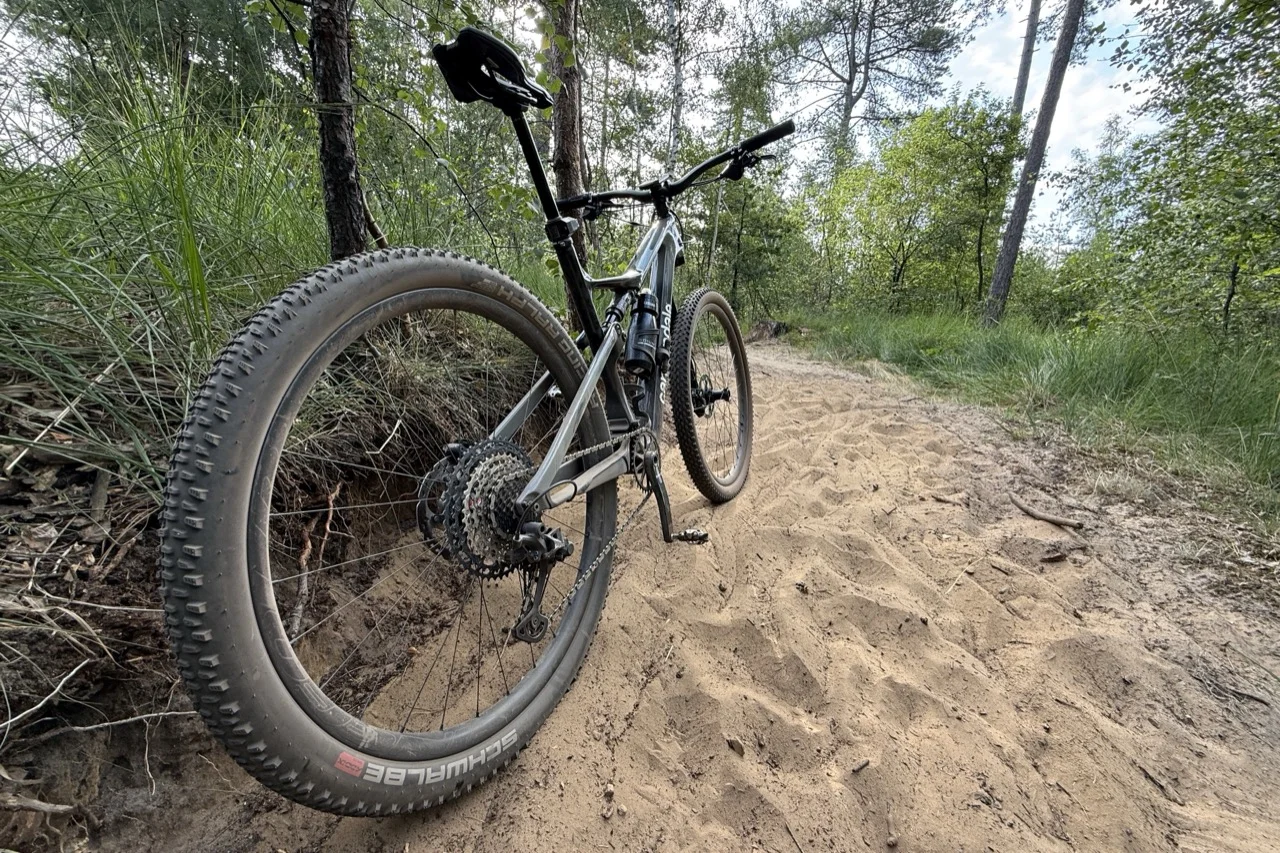
Chainrings on a 1× drivetrain (MTB, gravel) wear faster than 2× because every revolution uses the same ring. Plan accordingly.
Cross-chaining: a soft factor
Riding in the big-big or small-small extremes places more side load on the chain and the cogs you're using. The same Cycling Weekly piece quotes two mechanics with different views:
- Van der Hout: lists cross-chaining as a wear accelerator.
- Whittington: "Cross-chaining doesn't create the problems that it used to. It's a fractional problem with a modern groupset."
The honest read: it's not free, but with a modern 11/12-speed groupset and a clean drivetrain, it's a second-order effect. The 0.5 % chain threshold matters far more than your shift habits.
The maintenance routine
If you take nothing else from this post:
- Buy a chain checker. Park Tool CC-3.2 or CC-4.2. €15.
- Check every 500 km or before any long event.
- Replace the chain at 0.5 % (10-speed: 0.75 %).
- Skip-test the cassette every time you swap a chain. Hard pedalling on the small cogs. If anything jumps, replace.
- Eyeball the chainrings every second cassette. Daylight test, look for shark teeth.
- Track install distances for chain, cassette, and chainrings separately so you have data, not vibes, when making the call.
Track it in WatchMy.bike
This is where component-level tracking earns its keep. A few intervals you can copy onto your bike's components:
- Chain — distance interval at the low end of your range: 3,000 km road, 2,000 km gravel, 1,500 km MTB, half of those numbers for e-bike. Resets when you record a chain swap.
- Cassette — soft check-in at 8,000 km (road) so you start watching the skip-test result, replacement triggered by the skip test rather than the number.
- Chainrings — soft check-in every two cassette cycles.
Or open /chat and just say "set up chain wear tracking for my road bike at 3,000 km" — the assistant will create the component, link it to your bike, and configure the interval in one go.
The point isn't to obsess over the numbers. The point is that when the chain checker hits 0.5 %, you do the swap that day — not next weekend, not after the next group ride. That single habit is the difference between a €30 chain swap and a €120 drivetrain rebuild.
Want a system to actually catch this on time? Sign up free — track up to 3 bikes and unlimited components on the Steel plan without paying anything.