AirForce Max Review: Do You Really Need a Bike Blower?

•6 min read
Quick answer: Nobody needs a bike blower — a microfibre towel is free. The Dynamic Bike Care AirForce Max (240 W, 375 g, €119,99 list and regularly on sale) is for the rider who washes often and hates what towels can't reach. Brake calipers, cassette gaps, cable ports, pivot bearings: it moves water out of the places you'd otherwise leave wet. Whether that's worth real money depends on how you wash — my take below.
You've just washed the bike. It looks clean for exactly as long as it takes the water to find its way out of the frame ports. Then it dribbles down the seat tube, dragging a grey streak with it. The towel got the tubes. It didn't get the cassette, the caliper slots, or the bolt heads — and that's where water sits and corrosion starts.
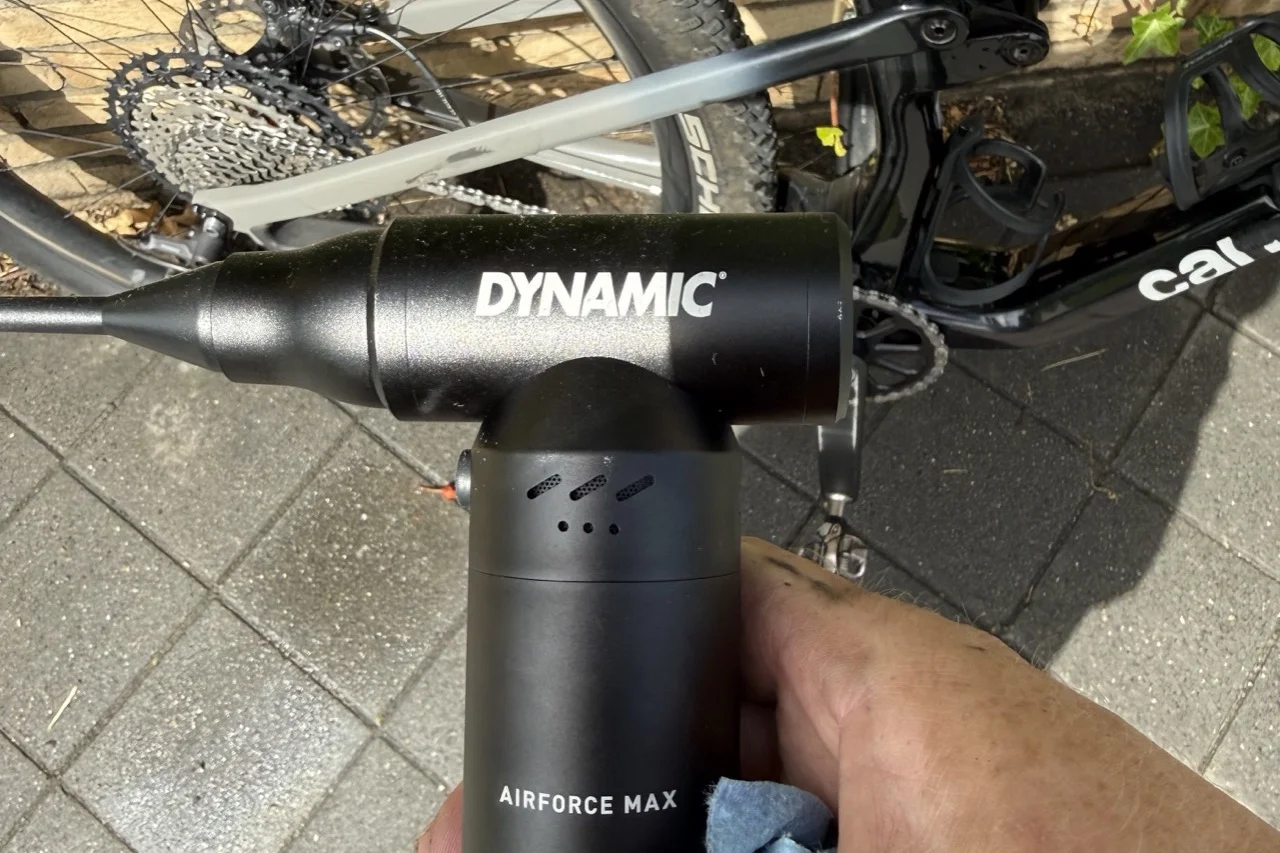
The car-detailing world solved this years ago with blowers. Dynamic Bike Care shrunk the idea to bike scale: a cordless, USB-C-charged aluminium blower shaped like an oversized torch.
I bought mine in February, direct from Dynamic: €84 on the pre-order promotion against the €119,99 list. That gap tells you how to shop for it — list price and street price are rarely the same number. Five months of wash days later, this review is what that €84 actually bought.
The purchase it actually replaced wasn't a towel. For a long time the plan was a workshop compressor — the "proper" solution. I kept not buying one. The AirForce Max is what ended the deliberation, from the other side of the power spectrum.
What It Is
| Spec | Value |
|---|---|
| Power | 240 W, four modes (50,000–130,000 rpm) |
| Air force | Up to 2.05 N in Turbo mode |
| Weight | 375 g claimed (376 g measured by road.cc) |
| Battery | 2000 mAh, USB-C, ~2–3 h charge |
| Runtime | 1 h 15 in Mode 1 down to 10 min in Turbo |
| Noise | 89 dB at full power |
| Body | Brushed aluminium, 2-year warranty (water damage excluded) |
Specs from the official product page; the measured figures are from road.cc's 2025 test.
The runtime numbers tell you how it's meant to be used. Turbo gives you ten minutes — thin on paper, until you realise drying a bike takes two or three.
What It's Like to Use
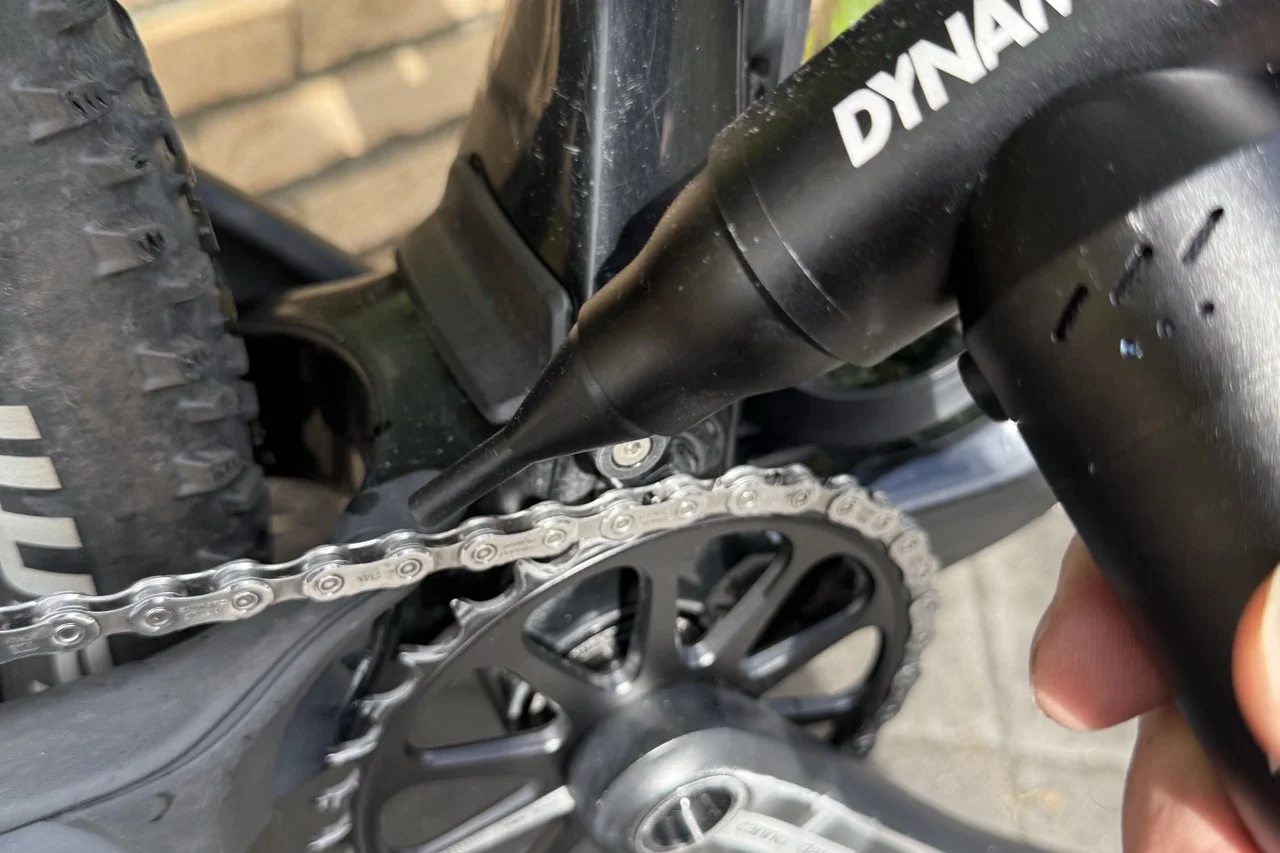
Where a towel can't follow: chainring bolts, chain rollers, the pivot behind them.
In practice I run it in the most powerful mode, always. The four-mode ladder is nice on paper, but when the job is pushing water out of a cassette you want all 130,000 rpm. The ten-minute Turbo runtime has never been the limit on a wash day. The noise is real at full power. It's also fine — this is outside work by nature, and it's probably still less loud than the compressor would have been.
The Case Against (Taken Seriously)
The "do you really need this" question deserves a straight answer, and the trade press already gave half of it. road.cc scored it 6/10: well built and impressively powerful, but loud — and crucially, not a substitute for re-lubing. Their corrosion test found a blower gets most of the water off a chain, but not enough to skip proper chain care afterwards.
That matches the physics. A blower displaces surface water brilliantly and does nothing about the water already inside a chain's rollers. Blow the bike dry, then lube — the blower replaces the towel, not the maintenance.
I'll say it: if you wash your bike four times a year, skip this and buy a better towel. The AirForce Max makes sense at weekly-wash frequency — winter riders, mountain bikers, anyone running disc brakes who's tired of squealing after every wash. Towel-touched or air-dried rotors are where that squeal comes from.
Where a Bike Blower Fits in a Wash Routine
A wash that ends wet isn't finished — trapped water is how bolts seize and bearings pit between services. The blower's real job is closing the wash properly, fast enough that you'll actually do it. The cost math of regular cleaning already pays for itself in component life. The blower is a convenience multiplier on a habit that was already worth money.
Verdict: The Compressor Question, Answered Sideways
A compressor beats this thing on raw power — no argument. But five months in, I think power was the wrong axis to compare on. A compressor lives bolted to one corner of a garage, next to the socket it needs. The AirForce Max goes wherever there's something to blow off. More often than I'd have guessed, that's not the bike — it turns out to be an excellent keyboard and laptop duster too.
At the €84 I paid as a pre-order early adopter: clearly the right call, and I'm glad the compressor never happened. At €119,99 list, the maths is the wash-frequency question from the top of this post. The honest summary: it doesn't have a compressor's power. The question is whether you need that power, when flexibility is the advantage you'll actually use every week.
How WatchMy.Bike Makes This Automatic
A clean bike is also the moment you see everything — pad thickness, chain condition, tyre cuts. WatchMy.bike turns the wash into a checkpoint: log the cleaning, and let distance-based alerts tell you when the next one is due instead of guessing from how the drivetrain sounds.
Set up these alerts and the wash day schedules itself:
- "Clean & lube chain" — recurring every 250 km, sooner in winter
- "Full wash + inspection" — recurring every 500 km
- "Measure chain wear" — recurring every 1,000 km, while the drivetrain is clean enough to measure honestly
Set up your first maintenance alert →
FAQ
Is a bike blower worth it?
If you wash weekly, yes. It closes the wash fast enough that you actually dry the spots that corrode — calipers, cassette, bolt heads, pivots. If you wash a few times a year, a better towel is the smarter €100 saving. Price changes the answer too: at the ~€80 street price the case is much easier than at the €119,99 list.
Can the AirForce Max dry a chain?
Mostly, but not completely. It blasts the surface water off, and road.cc's corrosion test showed moisture stays inside the rollers regardless. Blow the bike dry, then lube. The blower replaces the towel, not the chain care.
How long does the AirForce Max battery last?
Dynamic claims 1 hour 15 in the lowest mode down to 10 minutes in Turbo. That sounds short, but a full bike dry takes a few minutes — in five months the runtime has never been my wash-day limit. Charging is USB-C, claimed at 2–3 hours; road.cc measured 3h10.
Questions about wash-day gear? Reach out at marien@WatchMy.Bike.