SKIL's Visma | Lease a Bike Tools: What a 5 Nm Screwdriver and an 11 Bar Compressor Are Actually For

•14 min read
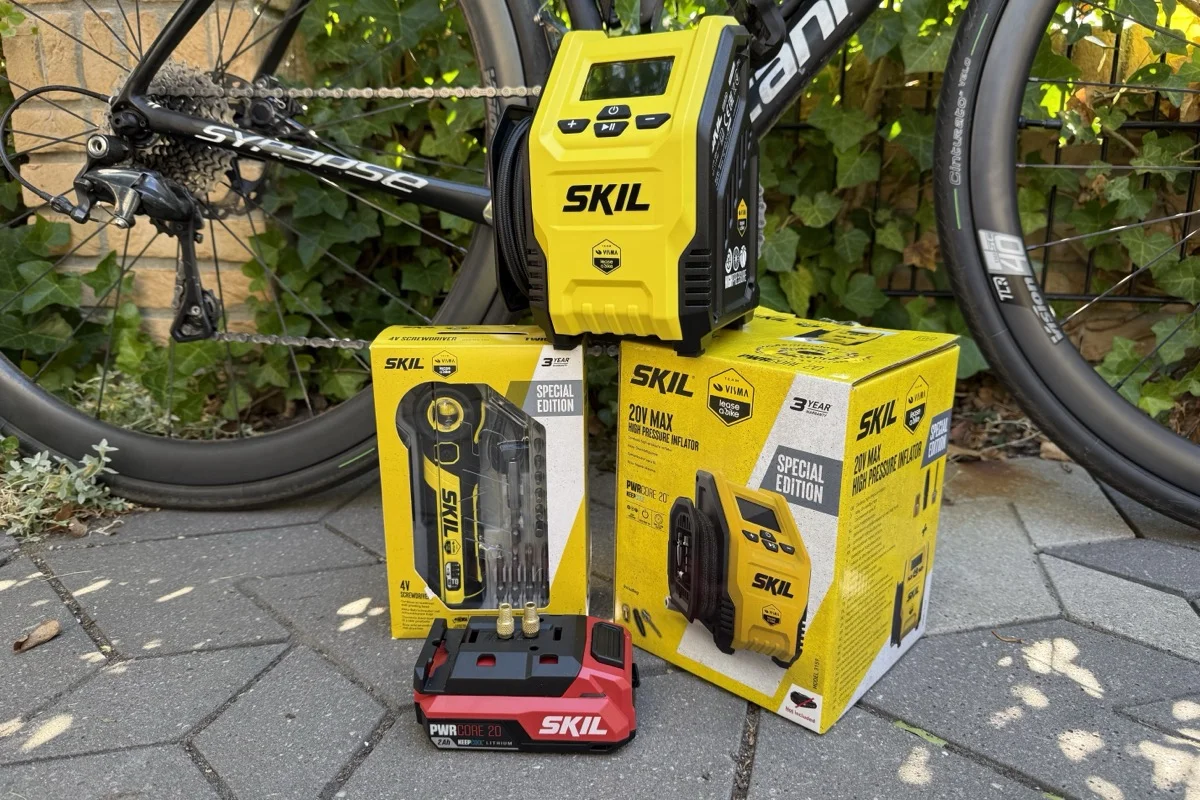
Quick answer: These are standard SKIL tools in team paint, not bike-specific tools — and two of them earn bench space anyway. The 3159 VL inflator (11 bar / 160 psi, 1.1 kg, €69.99 currently bundled with a €54.99 battery) is the one I'd buy, with one warning: if the valve adapter doesn't seal properly, the auto-shutoff stops early and lies to you. The 2714 VL screwdriver (5 Nm max, €49.99) is the one people will misuse. Its 5 Nm ceiling is not a torque setting, and on my own stem it's the bottom of the printed range. The early surprise is that both look like earning their keep more off the bike than on it.
Two tools, one battery, and the Synapse they were tested on.
There's a specific kind of tedium in bike maintenance that has nothing to do with skill. Mudguard hardware. Bottle cage bolts. Six rotor bolts per wheel, twice. A set of cleats. None of it is hard — all of it is thirty turns of a hex key while your wrist complains. That's the job a cordless screwdriver is supposed to take off you.
The question is whether a power tool belongs anywhere near a bicycle, given that bicycles are held together by bolts with torque figures printed next to them. SKIL sponsors Team Visma | Lease a Bike and sells these through the team webshop in team yellow, which invites exactly the assumption worth taking apart: that a tool wearing a WorldTour team's paint was designed for bikes.
What's Actually in the Box
Three line items, two tools. The battery is separate because the screwdriver doesn't use it — it has its own.
| Product | Model | Price | Notes |
|---|---|---|---|
| Cordless screwdriver ("Twist 2.0") | 2714 VL | €49.99 | 4 V, integrated battery, USB-C, 3-year warranty |
| PWRCORE 20 battery | 3142 AA | €54.99 | 2.0 Ah, USB-C PD output |
| High-pressure inflator | 3159 VL | €69.99 | 20 V, needs the battery above, 3-year warranty |
Read the pricing carefully, because my own receipt is a good lesson in how these promotions work.
I pre-ordered in early July off an Instagram promotion the team ran around the Tour de France Grand Départ, and the tools shipped on 30 July. The receipt reads: €89.61 subtotal excluding VAT, €0.00 shipping, €30.37 VAT, €119.98 total, and a line saying "Your savings: −€54.99".
That €54.99 is exactly the battery's price. The promotion wasn't a discount on the tools — I paid €49.99 and €69.99, both list. The promotion was a free battery, and the inflator can't run without one.
A bundled extra is only a saving if you'd have bought it. If you already own PWRCORE 20 batteries, that headline €54.99 "saving" is worth nothing to you and you've paid full sticker for two tools. Compare against the AirForce Max, where the launch promotion was a genuine price cut — €84 against a €119.99 list. Both are launch-window deals; only one of them lowers the price. Work out which shape you're being offered before the countdown timer does it for you.
The "VL" suffix is the only thing separating these from the 2714 GA and 3159 CA sold everywhere. Same castings, same specs, different paint.
The Screwdriver: 5 Nm Is the Whole Story
The 2714 VL is a 4 V stick screwdriver with an integrated 0.8 Ah battery, charged over USB-C in about 90 minutes. It turns at 240 rpm, has three torque settings selected by a TQ SELECT button and shown as three green LEDs on the barrel, a ¼" (6.35 mm) hex bit holder, an LED work light, and a head that pivots to 0°, 22.5° and 45°. It ships in a clear case with 27 bits and a magnetic holder.
Maximum torque: 5 Nm on a hard joint.
That's where most reviews stop and where a bike review should start.
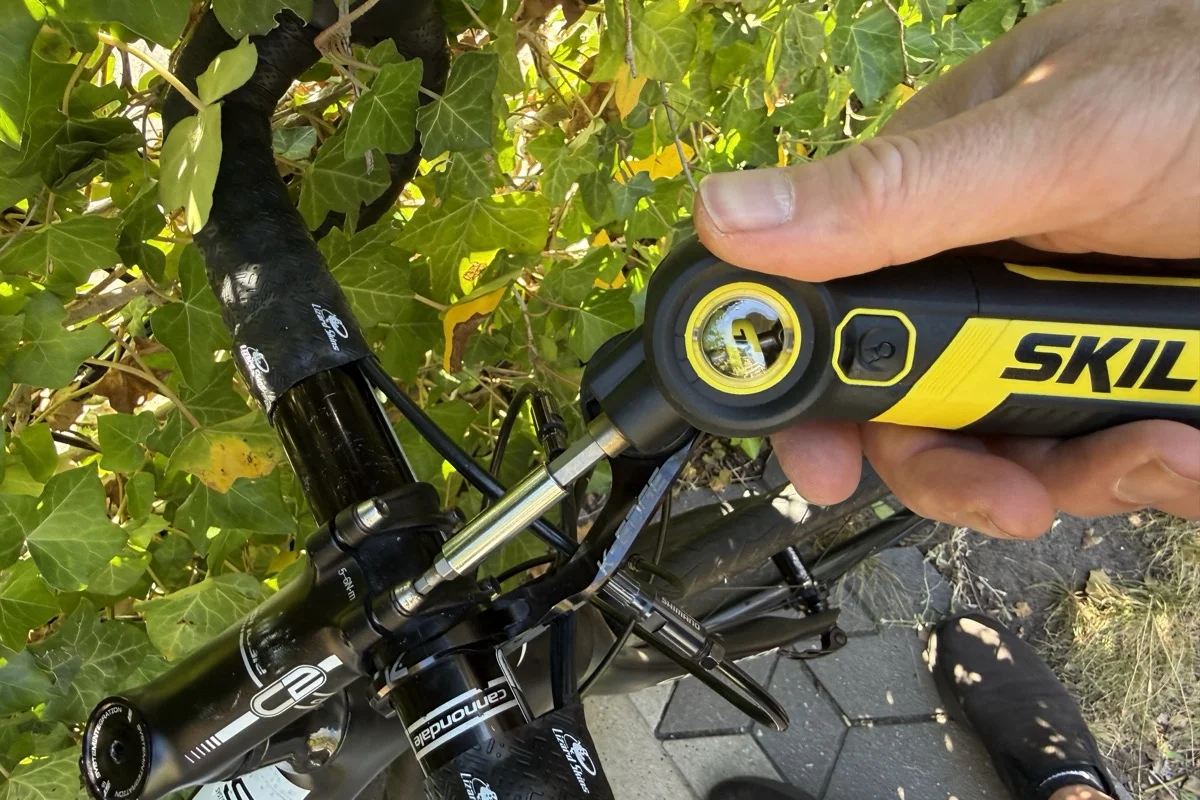
The stem is stamped 5–8 N·m. The tool stops at 5. That's the entire argument in one photo.
Here's what 5 Nm means against the bolts you'd point it at, using Park Tool's torque specifications:
| Bolt | Manufacturer spec | Inside the 2714's 5 Nm ceiling? |
|---|---|---|
| Disc rotor bolts, 6-bolt (Shimano) | 2–4 Nm | Yes — and easy to overshoot |
| Bottle cage bolts | ~3 Nm | Yes — and easy to overshoot |
| Seatpost binder (Campagnolo) | 4–6.8 Nm | Partly |
| My Synapse stem | 5–8 Nm (stamped) | Only the very bottom |
| Stem faceplate (FSA carbon) | 8.8 Nm | No |
| Disc caliper mount (Shimano) | 6–8 Nm | No |
| Derailleur mount (Shimano / SRAM) | 8–10 Nm | No |
| Saddle rail clamp (Shimano) | 20–30 Nm | No |
| Crank bolt (Shimano) | 34–44 Nm | No |
Read that in both directions, because it cuts both ways.
The 5 Nm myth: People will tell you a low-torque screwdriver is "safe for carbon because it can't over-tighten anything." That's half true, and the dangerous half is the other one. This tool can't reach my stem's 8 Nm ceiling — so it physically cannot crush a bar. But a Shimano rotor bolt wants 2–4 Nm and this thing will happily drive one to five. A three-position clutch is not a calibrated instrument; a decent torque wrench holds ±4–6%, a clutch holds nothing you'd want to publish.
So it has no business being the last thing that touches a torque-critical bolt. What it's good at is everything before that:
- Running fasteners down. Spin until the bolt seats, then finish by hand with a torque wrench. That's where the thirty wasted turns live.
- Disassembly. Nothing on the way out has a torque spec.
- Everything that isn't the bike. This is the early surprise. It fills the gap below a proper cordless driver — the jobs where dragging out the Makita is overkill and a hand screwdriver is tedious. Flat-pack, a loose cupboard hinge, battery covers on toys, the trainer riser, a bike box. It's small enough to live in a kitchen drawer rather than a workshop, and I suspect that's what will decide how often it actually gets used.
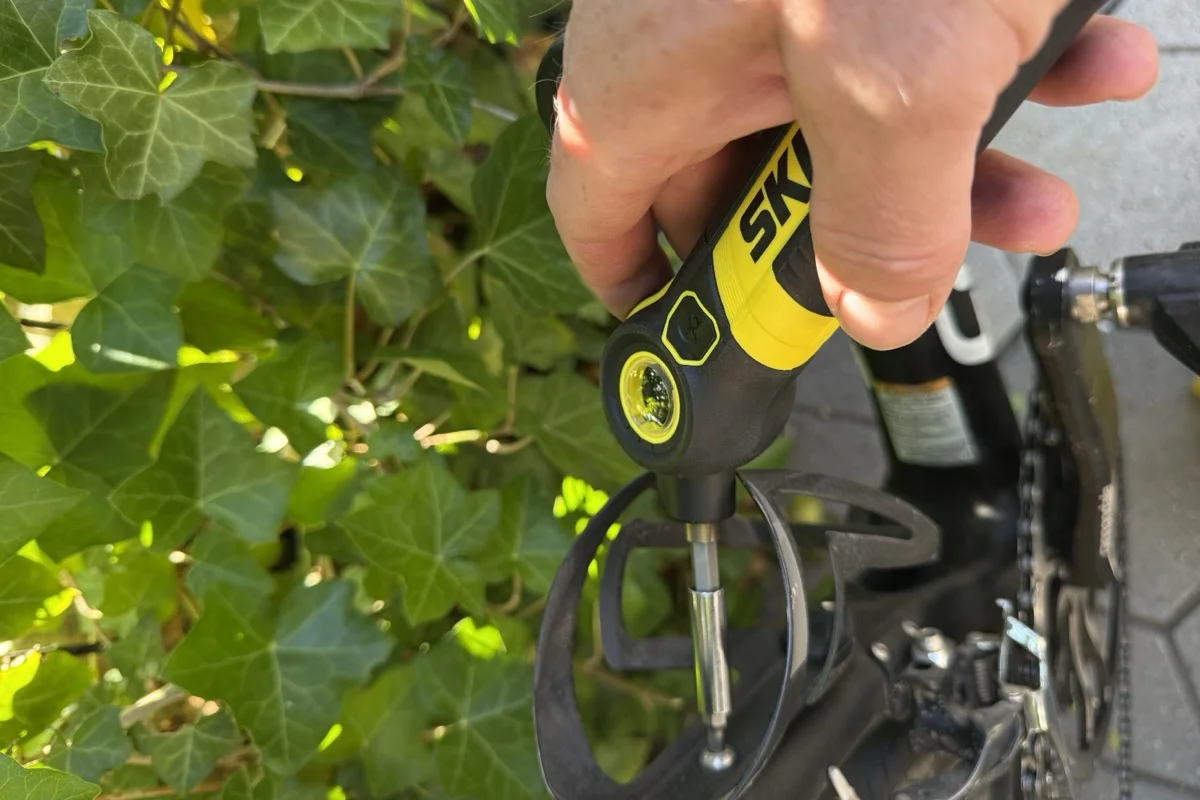
The 45° head plus one of the 50 mm bits clears a fitted bottle cage. This is the job it's actually for.
The pivoting head is the part I expected to be a gimmick. With a long bit it reaches a cage bolt with the cage still on the frame, which is a real awkward-angle win.
The Inflator: 11 Bar Is the Wrong Number to Care About
The 3159 VL runs off the PWRCORE 20 battery, weighs 1.1 kg, measures 158 × 211 mm, and pushes up to 11 bar (160 psi). The LCD shows live pressure large with the target above it, in bar. Set a target, press play, walk away, and it stops itself.
Eleven bar is a car-and-motorbike number. It's roughly double what a road tyre wants and six times what a mountain bike tyre wants:
| Setup | Typical pressure | Share of the 3159's range |
|---|---|---|
| Road, 28c | 4.1–4.8 bar / 60–70 psi | ~40% |
| Family car | 2.0–2.5 bar / 29–36 psi | ~20% |
| Gravel, 40c | 2.1–2.6 bar / 30–38 psi | ~22% |
| MTB trail, 2.4" | 1.4–1.7 bar / 20–24 psi | ~14% |
Note where the car sits. Everyone assumes a car tyre is the high-pressure job that justifies an 11 bar rating, and it isn't — a family car runs about the same pressure as a gravel tyre. Nothing in a normal household gets close to the top of this tool's range.
(Sweet spots from the tyre pressure post — and if you haven't run your own numbers, the pressure calculator will probably tell you to drop 0.7 bar / 10 psi.)
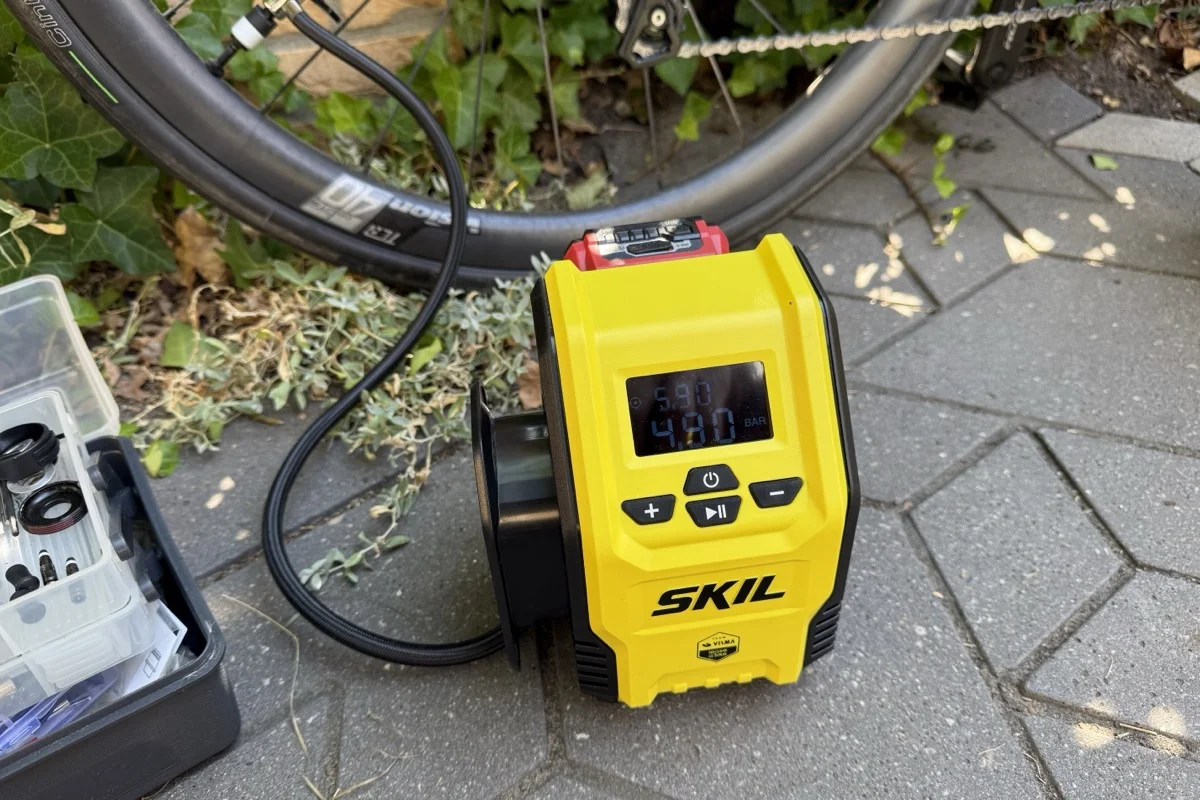
Mid-inflation on the Synapse: 4.80 bar / 70 psi live, 5.90 bar / 86 psi target.
I'll say it: max pressure is a marketing spec and reviewers keep quoting it because it's the easy one. For a cyclist the figures that matter are resolution and accuracy at the bottom of the range. A gauge that reads ±0.2 bar is a rounding error on a car tyre and a 13% error on a mountain bike tyre at 1.5 bar / 22 psi. Nobody tests inflators down there.
The Adapter Problem Nobody Warns You About
Here's the finding that surprised me, and it's the reason this section exists.
I run Schwalbe Clik valves, so I fitted the Clik adapter to the SKIL's hose. It didn't work properly at first — the compressor kept shutting off early, well short of the target I'd set. Nothing looked wrong. The display just decided it was done.
The adapter wasn't sealing. Fitting a smaller rubber ring inside it fixed the problem completely, and it has inflated correctly on every run since.
Why this matters beyond Clik valves: a battery inflator measures pressure at the pump, not in the tyre. A connection that leaks or restricts makes the pump see a pressure the tyre never reached — so the auto-shutoff fires early and the display confidently reports a number that isn't true. A digital readout is not evidence of accuracy. If the reading looks plausible but the tyre feels soft, suspect the adapter before you suspect the tyre.
That's an argument for checking any new inflator against a gauge you trust on day one, whatever valve you run.
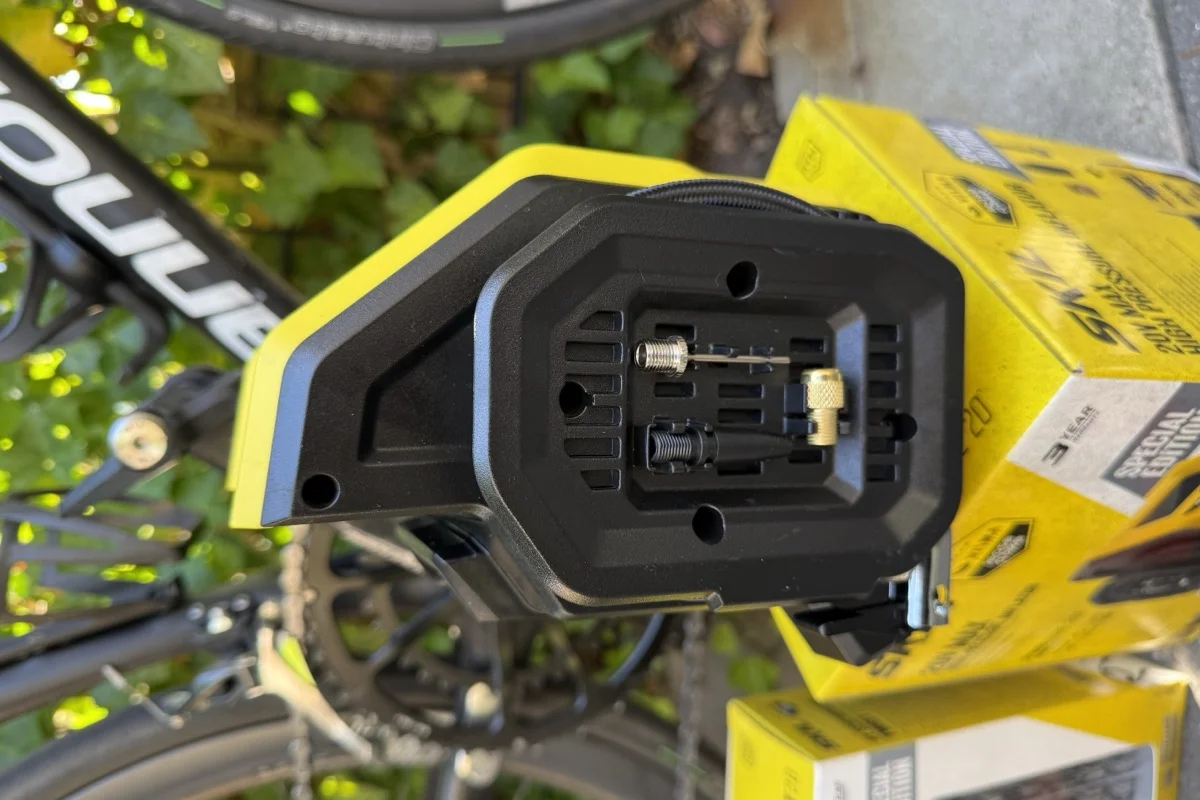
Brass Presta adapter, ball needle and pinch adapter live in the base; the hose wraps around it.
Credit where it's due on the hardware: the Presta adapter SKIL ships is brass, not plastic, and it stores in a moulded compartment in the base along with the ball needle and pinch-valve adapter. The hose wraps around the same base. Nothing to lose in a drawer, which matters more than it sounds — this is the drawer in question:
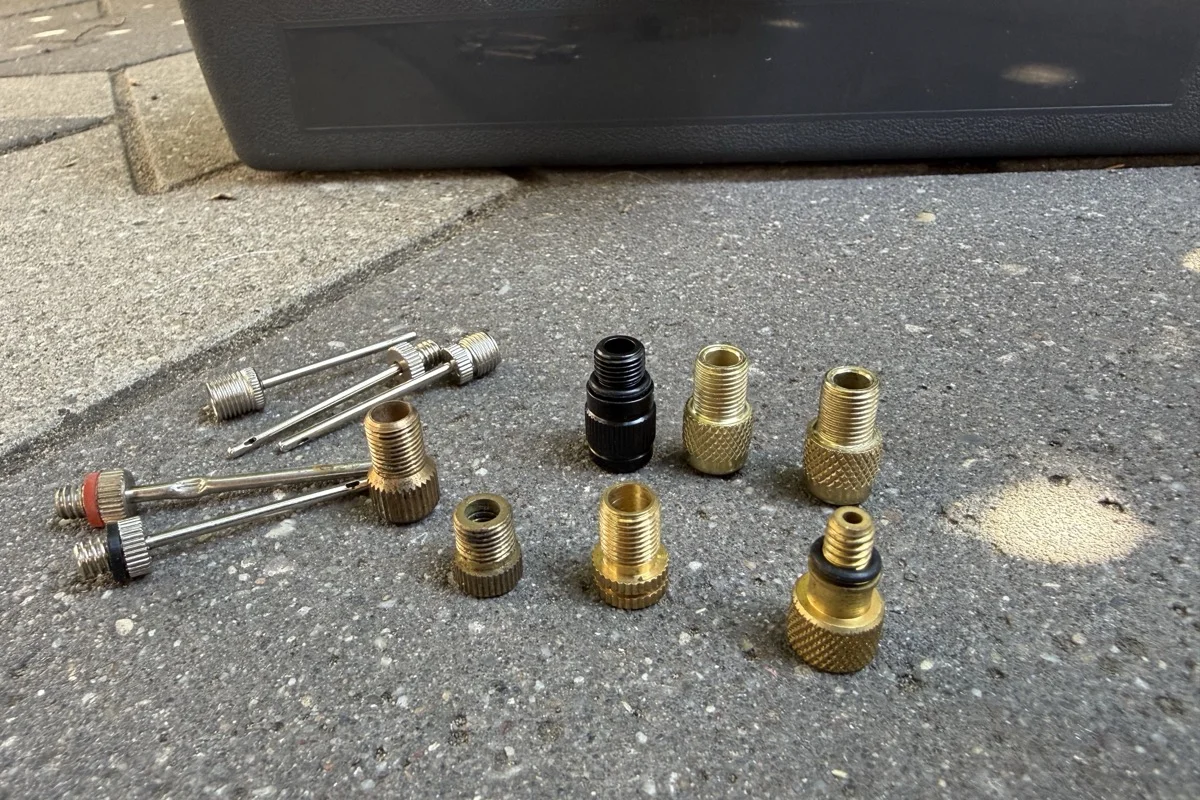
Fifteen years of valve adapters. Every one of them was essential exactly once.
Still to Test — I'll Update This Post
This review is written two days after the tools arrived, so treat it as first impressions with a receipt rather than a long-term verdict. Six things I'm still measuring, and I'll come back and fill in the numbers here rather than write a second post:
- Accuracy against a known-good gauge at 1.5, 3.0 and 5.0 bar (22 / 44 / 73 psi) — one consistent reference across all three, now that the Clik adapter seals.
- Overshoot — does it stop at target, or coast past? Re-read 30 seconds after shutoff.
- Smallest settable increment, and whether the display switches to psi.
- Tubeless seating — almost certainly no (that needs volume, not pressure), but every mountain biker will ask.
- Tyres per charge on the 2.0 Ah battery, road and MTB.
- Noise, roughly.
Is the Team Edition Worth Anything?
No, and SKIL isn't really pretending otherwise. The VL variants are the standard 2714 and 3159 in Visma yellow with a team badge on the housing. No bike-specific tooling, no bike torque presets, no cycling accessory the standard versions don't also ship.
What you're buying is paint and, indirectly, sponsorship. If you like the team that's a real reason — people buy replica jerseys on the same logic and nobody calls that irrational. Just don't buy it believing the livery implies engineering. Check whether the plain 2714 GA and 3159 CA are cheaper the week you're buying, and decide with that number in front of you.
The ranking as it stands:
- The inflator earns its place. Not because it's fast or clever, but because set-and-walk-away changes how often you actually check pressure. Guessing by thumb is how tyres end up 1 bar / 15 psi off. It also does the car, which removes the trip to the petrol station air line — a job I've always put off for weeks. Just verify it against a gauge you trust before you believe it.
- The screwdriver earns its place, but mostly off the bike. On the bike it's a run-down tool that hands over to a torque wrench, and nothing more. Around the house it sits in the gap where a full-size driver is overkill and a hand screwdriver is tedious, which is a gap most people have and few people fill. If you're buying it as a bike tool you'll be underwhelmed; if you're buying it as the small driver you never had, it's the better deal of the two.
- The battery is the real purchase. It's the entry ticket to a 20 V platform, it charges a phone over USB-C PD, and right now the inflator bundle effectively gives it to you.
How WatchMy.Bike Makes This Automatic
Better tools don't help if you can't remember when you last used them. The bolts a screwdriver runs down are the ones that quietly back out — rotor and cage bolts don't announce themselves until something rattles.
Set up these alerts and the checks stop depending on memory:
- "Torque-check cockpit and rotor bolts" — recurring every 3 months
- "Check tyre pressure against calculator" — recurring every 2 weeks
- "Charge workshop tool batteries" — recurring every 3 months, so the inflator isn't flat the morning you need it
Set up your first maintenance alert →
FAQ
Can you use a cordless screwdriver on a bike?
Yes, for running fasteners down and for disassembly. No, for final tightening on anything with a torque spec — which is most structural bolts on a bike. A clutch setting is not a calibrated torque value. Spin it down with the driver, finish with a torque wrench.
Is the SKIL 2714's 5 Nm limit safe for carbon parts?
It's at or below the spec for most cockpit bolts — my own stem is stamped 5–8 Nm — so it can't reach the crush threshold there. But it's above the 2–4 Nm spec for Shimano rotor bolts and bottle cage bolts, so it can over-tighten small fasteners. Low maximum torque is not the same as safe torque.
Why does my battery inflator stop before reaching the target pressure?
Most often the valve connection isn't sealing. The pump measures pressure at its own head, so a leaking or restrictive adapter makes it read high and shut off early. On my Clik valve adapter, fitting a smaller rubber ring inside it fixed the problem. Check the adapter before assuming the pump is faulty.
Can the SKIL 3159 inflate a bike tyre?
Yes — 11 bar / 160 psi is far more than any bicycle tyre needs, and the brass Presta adapter stores onboard. The relevant question is accuracy at low pressure, not whether it reaches high pressure.
Will it seat a tubeless tyre?
Almost certainly not on its own. Seating a bead needs a large, fast volume of air, which is what a tank-fed workshop compressor or a dedicated tubeless charger provides. A 1.1 kg battery inflator delivers pressure, not volume.
Are the Team Visma | Lease a Bike editions different from standard SKIL tools?
Only cosmetically. The 2714 VL and 3159 VL match the 2714 GA and 3159 CA on specification, down to the 3-year warranty. Compare prices against the standard versions before buying.
Running these in your own workshop, or think I'm wrong about the screwdriver? Email me at marien@WatchMy.Bike.