Bike Maintenance Is a Memory Problem, Not a Skill Problem

•11 min read
Quick answer: Knowing what wears out on a bike is the easy part — every cyclist knows a chain has a lifespan. What fails is remembering when you fitted it, how far it has run, and exactly which one it was. Bike maintenance is a memory problem, not a skill problem, and it compounds because the intervals don't share a unit: chains in kilometres, cassettes in chains, suspension in ride hours, brake fluid on the calendar. The fix isn't a better memory. It's writing each part down once, at install, and letting your ride data keep the odometer current.
A new bike is silent.
Nothing creaks, nothing skips, nothing rubs. The shifting is precise in a way it will never be quite as precise again. And more than anything, the bike asks nothing of you. You ride it, you put it away, you ride it again. There is no decision to make, because everything on it is new and everything on it is fine.
That state does not last, and losing it is not the interesting part. Every cyclist knows a bike wears out. What is interesting is the specific way you lose track of it.
A few hundred kilometres in, you give it a proper clean. And somewhere between the chain and the cassette, the cleaning turns into inspecting. You look closer at the pads. You run the chain through your fingers. You ask the first real question: is that normal wear, or is that too much wear.
The First Fix Is the Trap
So you fit a new chain. Maybe new pads at the same time.
It takes an evening. The bike feels new again, and there is something deeply satisfying about that. One part, one decision, one afternoon in the shed. You did not need a system. You did not need a record. You needed a 30 euro chain and a chain tool.
This is the moment the real problem gets hidden, and it gets hidden precisely because the fix worked so well. Nothing about that first replacement suggests you should be writing anything down. Why would you. You know exactly what you just did.
The Second Round Is Never One Part
The second time around it is never one part.
By then the cassette has been running with a worn chain long enough to matter. The cables have stretched and the outers have dirt in them. The bar tape is grey where your hands go. If you ride disc, the fluid is a year old. If you ride off road, the fork has hours on it that nobody has counted.
The problem is that none of these intervals line up. They are not even measured in the same unit.
| Part | Typical interval | Measured in |
|---|---|---|
| Chain | 2,000 to 5,000 km, depending on conditions and drivetrain | Distance, checked with a wear gauge |
| Cassette | Every 2 to 3 chains | Chains, not kilometres |
| Brake pads | Highly variable, terrain and weather driven | Visual thickness |
| Cables, outers and brake fluid | Roughly annually | Calendar time |
| Suspension | Around 50 hours for lowers, 100 to 200 for a full service | Ride time |
Distance, ride hours, calendar time, and one part measured in units of another part. Adjust these numbers to your own riding, because that is the point of the table rather than the numbers themselves — the full lifespan chart has the condition multipliers if you want them. Nobody holds a schedule like this in their head, and nobody should be expected to.
The Question You Cannot Answer
Here is where it actually breaks down.
You are standing in the shed with a cassette in your hand, and the question is no longer whether it is worn. You can see that it is worn. The question is how it got there.
When did I fit this. How many kilometres has it done since. Was that before or after the wheel swap. Was it on the bike during that wet autumn, or did that happen to the previous one.
You cannot answer that. Not accurately, not six months later, and I say that as someone riding since 2008, past 50,000 kilometres, who wanted very much to be the kind of person who could.
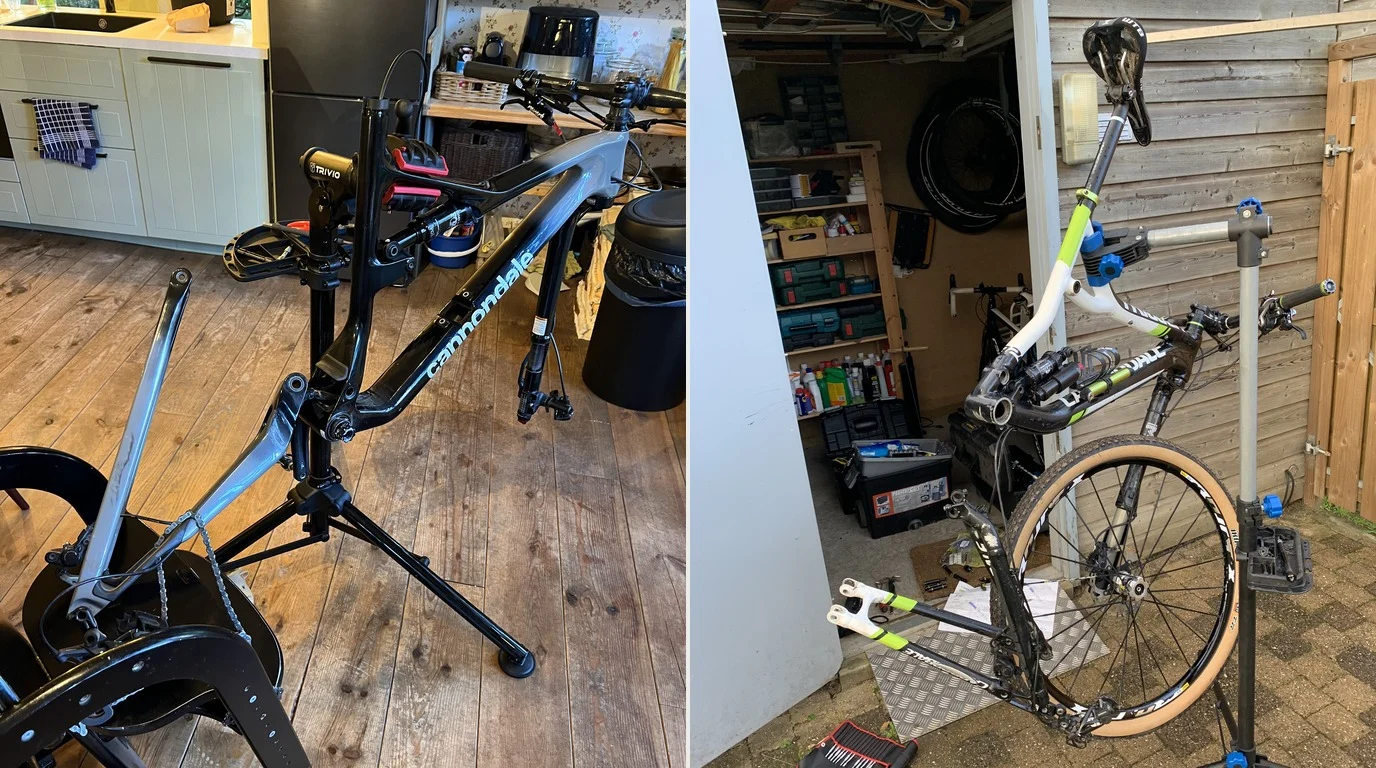
Both bikes at the top of this page are mine, both caught mid-strip: the Trigger on the left with the wheels out, the Scalpel on the right with the fork off and the bottom bracket shell empty. I can tell you every part on both of them right now, because it is written down. Before I built this, a photo like that was the only record I had — and a photo does not tell you how far anything has run.
And then comes the second question, which is worse.
What exactly is on the bike.
Which chain is it, and in which speed. Which pad compound, resin or sintered. Which rotor size, and which mount. Which bottom bracket standard, which cassette range, which derailleur cage length. You knew every single one of those things on the day you fitted the part, because you had just chosen it, ordered it, and unwrapped it. That knowledge was complete and it was free.
Six months later it is gone. So you end up in the shop describing a part from memory, or holding the old one up to your phone camera, or ordering something that turns out to be almost right.
That is the thing I kept coming back to. Knowing what wears out on a bike is the easy part. Every cyclist knows a chain has a lifespan. The part that fails is remembering when you fitted it, how far it has gone, and exactly which one it was.
Bike maintenance is not a skill problem. It is a memory problem.
Why the Usual Workarounds Do Not Hold
Everyone improvises a solution, and every improvised solution fails in the same place: the mileage.
The receipt in the drawer has the date and the exact model, which is more than most methods manage — but it does not have the bike. Two years and three drawers later, you have a receipt for a chain and no idea which frame it went on. The note in your phone has the part and sometimes the date, and no mileage, because mileage is not a fact you write down once. It changes every time you ride. The spreadsheet actually has all of it, and that is exactly why it fails: it needs you to open it after rides. Mine had two entries. I know how this goes. (Where each of the four methods breaks, in more detail than this post needs.)
And underneath all of it, the frustrating part: the data already exists. Every ride you upload is recorded to the metre. It just never reaches the parts that are wearing out.
Document It Once, Then Update at the Swap
The only moment you reliably know everything about a component is the moment you install it.
That is when the model name, the spec, the size, the price and the date are all sitting in front of you. Not a week later. Not when it starts making noise. Right then, with the packaging still on the bench.
So write it down then. Once. And then update it at the next swap, which is the only other moment you will have the same complete picture.
That is the whole discipline. It is not a habit you maintain daily, it is two moments per component per lifetime. And what you get back is not a better memory. It is not needing one. The bike carries its own history, and you stop being the weak link in it.
That is what peace of mind means in this context. Not knowing that everything is fine, but knowing that you can find out in ten seconds.
Your Judgement Still Leads
One thing needs saying clearly, because it is where a lot of maintenance software oversells itself.
I'll say it: the numbers do not decide anything. A chain at 4,000 kilometres can be in good shape and a chain at 2,000 can be finished. It depends on where you ride, what the weather did, how you shift under load, how clean you kept it, what drivetrain you are running, and how much you weigh. There is no kilometre figure that tells you a part is worn.
Your hands, your ears and a wear gauge decide. That does not change.
What changes is what you know when you walk up to the bike. Checking a chain while guessing at its history is one thing. Checking it while knowing it has 3,200 kilometres on it, that it went on in March, and that it is a specific model you have used before, is something else. The data does not replace the judgement call. It gives the judgement call something to work with.
What WatchMy.bike Actually Does
Which brings me to what I built. (The longer story of how a personal ride site slid into a component tracker is over here — this post is the problem it was answering.)
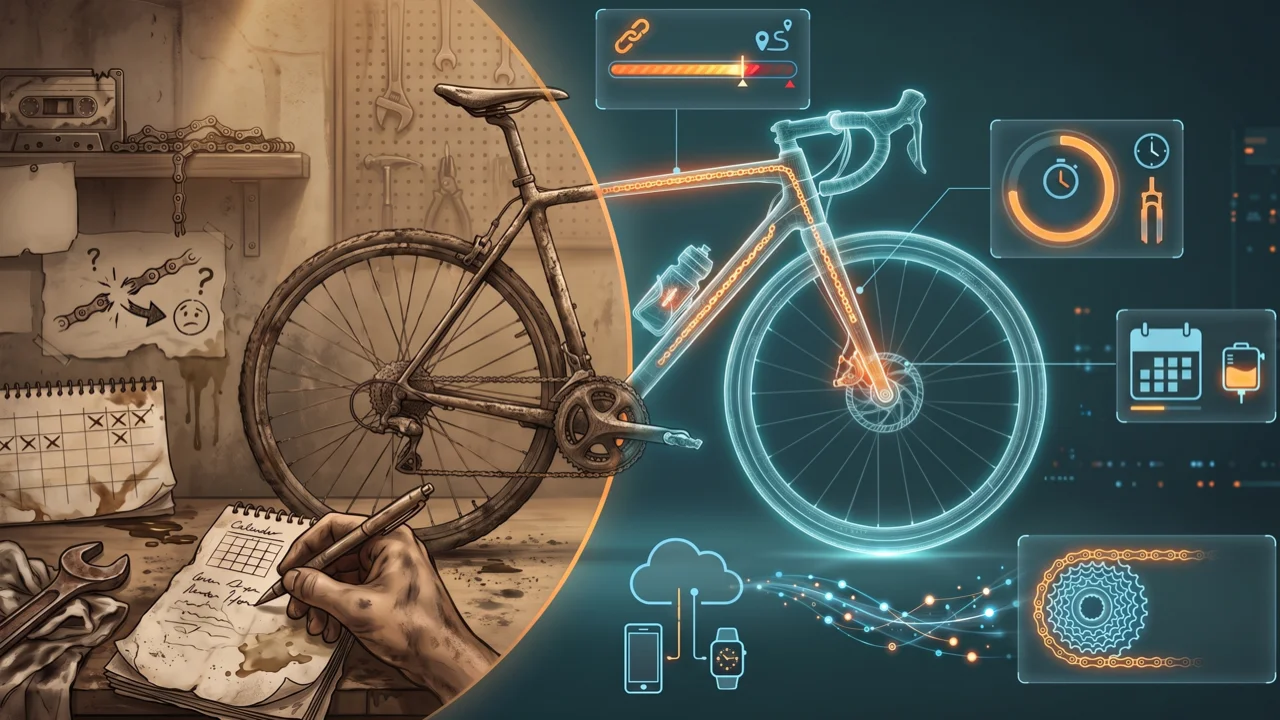
Your rides sync from Strava, and the kilometres land on the components you actually installed, not on the bike as a vague total. Every part carries its model name, its install date and its own mileage, and on the paid plans, its cost per kilometre. Reminders can run on distance, on ride time, or on a calendar interval, because as the table above shows, no single unit covers everything.
When you swap a part out, the old one keeps its history instead of being overwritten — its distance freezes at the uninstall date and stays on the record. Over a few seasons that turns into something useful: you start to know what your own intervals are, on your own roads, rather than what a manufacturer suggests.
If you want to see what that looks like rather than read about it, my own bikes are public at watchmy.bike/p/marvos.
Where This Goes
The app is the current answer. The ambition is bigger than the app.
In two or three years I want a reflex to exist that does not exist today. You buy a bike, new or second hand, and before the first ride you set up its digital twin. Frame number, groupset, every component with its model name and the day it went on. Five minutes, once.
From that point the bike keeps its own record. And when you sell it, the record goes with it.
That last part is the one I think matters most, and it is the reason this is not only a maintenance idea. I bought the Scalpel second-hand myself, so I know the gap from the buyer's side: I have no idea what its real mileage was before it reached me, and I am not convinced the seller did either.
Two identical second-hand bikes, same year, same spec, same photos. One of them comes with a documented component history where the mileage was synced automatically from rides rather than typed in by the seller. That bike is worth more, and it should be — the condition-grade spread on a used bike is measured in hundreds of euros, and the grade is set by what the seller can prove.
No receipt drawer can do that. A spreadsheet cannot do it either, because the buyer has no reason to trust it.
I want WatchMy.bike to be the number one bike management app in the world. But that only happens if the reflex comes first, so the reflex is what I am building toward.
How WatchMy.bike Makes This Automatic
You do the two moments — install and swap. The kilometres take care of themselves.
Three alerts that cover the three clocks:
- "Measure chain wear" — recurring every 1,000 km
- "Fork lower-leg service" — recurring every 50 riding hours
- "Brake bleed" — recurring every 12 months
I am the developer, I ride the bikes, and I built this because I could not answer a question about my own cassette. If that sounds familiar, you know exactly which problem I am talking about.
Marien
Questions about tracking your own components? Reach out at marien@WatchMy.Bike.