How Long Do Bike Parts Actually Last? The Complete Lifespan Chart

•10 min read
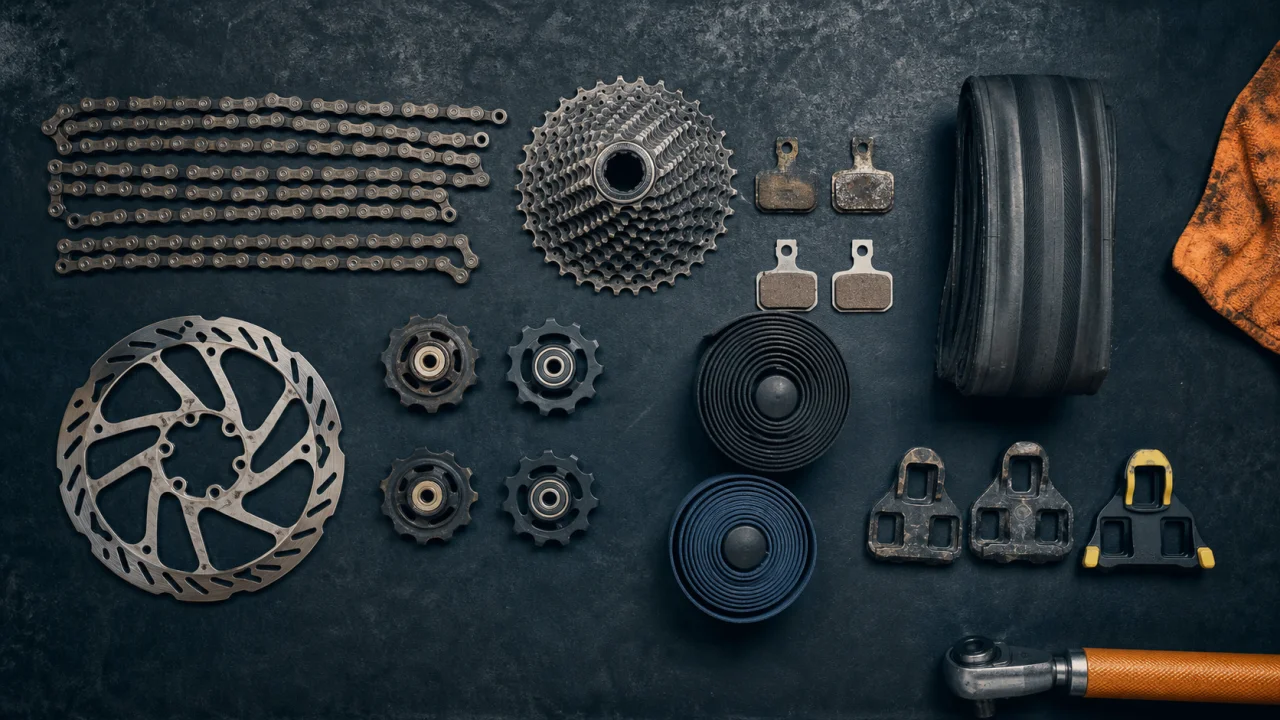
Quick answer: A chain lasts 2,000-5,000 km (replace at 0.5% elongation on 11/12-speed), a cassette survives 2-3 chains, road tires go 3,000-6,000 km on the rear and roughly double that on the front, disc pads 800-5,600 km depending on compound, and bearings run one to several seasons before they need attention. Suspension is measured in hours, not kilometres: 50 hours for a RockShox lower-leg service, 100-200 hours for a full damper overhaul. Then the multipliers hit: wet winters and mid-drive e-bikes can cut most of these numbers in half.
You replace your chain when it feels rough. Your tires when you can see the casing. Your brake pads when the lever comes back to the bar on a descent. In other words: late, every time, and each one of those late replacements quietly took something more expensive with it.
The frustrating part is that this information exists. Manufacturers publish wear thresholds, test labs publish endurance data, and mechanics have known the chains-per-cassette rule for decades. It has just never been in one place, adjusted for how you actually ride. This is that chart, with the receipts, and with honest labels on the numbers nobody can back up.
The Master Lifespan Chart
Distances assume a mechanically sympathetic rider in mixed-but-mostly-dry conditions. The multipliers further down adjust for everything else.
| Component | Typical lifespan | Replace / service when | Source basis |
|---|---|---|---|
| Chain (11/12-speed) | 2,000-5,000 km | 0.5% elongation | Park Tool spec, CyclingTips 3,000-hour test |
| Cassette | 2-3 chains (8,000-16,000 km) | New chain skips under load | Zero Friction Cycling |
| Chainrings | 4-6 chains | Shark-fin teeth, chain suck | road.cc |
| Road tires (rear) | 3,000-6,000 km | Wear indicator gone, squared profile | Continental/Vittoria, BicycleRollingResistance |
| Road tires (front) | roughly 2x the rear | Cuts, cracking, age | BicycleRollingResistance endurance test |
| Gravel tires | 2,000-5,000 km | Tread gone, sidewall damage | Schwalbe |
| MTB tires | 800-1,600 km | Rounded knobs, lost cornering grip | Mountain Bike Action |
| Disc pads (resin) | 800-3,200 km | Under 3 mm total pad | consensus, see below |
| Disc pads (sintered) | 1,600-5,600 km | Under 3 mm total pad | consensus, see below |
| Rotors | no km figure exists | Below stamped minimum (Shimano 1.5 mm, SRAM 1.55 mm) | Shimano/SRAM specs |
| Brake fluid (DOT) | 12 months | Calendar, not feel | SRAM service guide |
| Brake fluid (mineral) | ~24 months | Spongy lever, heat fade | Shimano-ecosystem practice |
| Tubeless sealant | 2-6 months | Dried out, punctures not sealing | Stan's, Orange Seal, Silca |
| Shift cables + housing | 2-3 years (rear sooner) | Sluggish shifts that indexing will not fix | Road Bike Rider, Bikerumor |
| Bottom bracket | 5,000-16,000 km | Grinding, play, creaks | shop consensus |
| Hub bearings / freehub | yearly service | Gritty spin, noise | DT Swiss, Chris King |
| Headset bearings | 1-2 years, wet riders sooner | Notchy steering, creaks after wet rides | community consensus |
| Jockey wheels | 10,000-16,000 km road, far less in mud | Pointed or rounded teeth | road.cc |
| Suspension fork lowers | 50 hours (RockShox), 30-100 h (Fox) | Hour counter, not feel | RockShox/Fox service docs |
| Fork/shock full overhaul | 100-200 hours | Hour counter or annually | RockShox/Fox service docs |
| Dropper post | 200-600 hours (Reverb), 300 h (Fox Transfer) | Sag, slow return | RockShox/Fox kits |
| Cleats | 4,800-8,000 km | Wear indicator visible, sloppy engagement | Shimano, Look |
| Di2/AXS battery | 500+ charge cycles, 5-10 years | Rapidly shrinking range per charge | Shimano spec |
| Bar tape | ~1 year | Hardened, torn, lost tack | Selle Italia |
| Helmet | 3-5 years, or any crash | Age or a single impact | Snell, MIPS |
| Carbon bars/post/frame | event-based, not age-based | Any crash or impact, full stop | manufacturer guidance |
Three of these rows deserve a closer look, because they are where the most money changes hands.
The Drivetrain: One Cheap Part Protects Three Expensive Ones
A chain is the only drivetrain part with a precise, measurable wear threshold: 0.5% elongation on 11 and 12-speed, 0.75% on 10-speed and older. A €15 chain checker turns replacement from a guess into a measurement.
The distances vary more than most riders expect. In the CyclingTips wear-rig test (over 3,000 hours of machine time), 11-speed chains averaged 2,200 km to the 0.5% mark, with the worst chain finished at 1,694 km and the best passing 3,400 km. Waxed chains from Zero Friction Cycling's ongoing lab program hold their wear rate dramatically longer, because a re-wax fully resets contamination in a way drip lube never does.
Miss the 0.5% window and the worn chain reshapes your cassette to match itself. That is the mechanism behind the 2-3 chains per cassette rule: replace chains on time and the cassette survives several of them; run one chain into the ground and it takes the cassette (and eventually the chainrings) with it. I covered the money side of this in Cassette and Chainrings: When the Chain Forces You to Replace Them Too.
The 12-speed myth: more gears do not mean faster wear. The same test data shows SRAM Eagle 12-speed chains passing 5,000 km with wear to spare, outlasting the 11-speed field by a wide margin. Chain durability has improved with every added sprocket, not degraded. If you are nursing an old 10-speed because "modern drivetrains wear out fast," the data says the opposite.
Rubber: The Rear Wears Twice as Fast
Continental's GP5000 endurance data (via BicycleRollingResistance) is the cleanest public test we have: the front tire projected past 20,000 km, while the rear, carrying the drive load, was done around 10,000 km in lab conditions. Real-world reports cluster lower: 3,000-6,000 km for a rear road tire is the realistic window, and racing compounds sit at the bottom of it.
Mileage is only half the trigger, though. Squared-off profiles, exposed casing, and recurring punctures end a tire regardless of the number. The full visual checklist is in When to Replace Your Bike Tires.
Tubeless riders have a second clock running: sealant dries out in 2-6 months depending on brand and climate. A tire that will not seal a thorn puncture is not protecting you, no matter how much tread is left.
Brakes: One Honest Number, One That Does Not Exist
Pad life is the least manufacturer-documented number in this entire chart. Shimano and SRAM publish no mileage figures, because terrain and braking style swing the result by 4x. The consensus ranges (resin 800-3,200 km, sintered 1,600-5,600 km) are directional. The measurable trigger is pad thickness: below roughly 3 mm including the backing plate, you are shopping. The feel-and-look guide is in Brake Pads: The Cheapest Part on Your Bike.
Rotors, by contrast, have an exact spec and no mileage estimate at all: Shimano stamps Min.TH=1.5 on the rotor face, SRAM's floor is 1.55 mm. Measure with calipers once a season and stop thinking about it.
Fluid is a calendar item, not a feel item. DOT fluid absorbs moisture through the hose walls and wants a yearly bleed; mineral oil systems stretch to two years. Why the two chemistries age so differently is covered in Brake Fluid 101.
Bearings: The Quiet Season Counters
Bottom brackets, hubs, and headsets fail slowly and announce it late. The honest summary of the available guidance:
- Bottom bracket: 5,000-16,000 km for modern outboard-bearing units, with wet riding pushing you toward the bottom of the range. Diagnosis and the service-or-replace decision tree are in Bottom Brackets: When to Service, When to Replace.
- Hubs: DT Swiss says once a year; Chris King says every 6-12 months, and their bearings then run more or less indefinitely. Time-based, because grit exposure matters more than distance.
- Headsets: the lower bearing takes rider weight plus wheel spray and dies first. There is no manufacturer lifespan figure here at all; the pattern in every workshop is the same, though: a creaking headset after a wet season is the lower race asking for grease.
None of these have a wear indicator you can see from the saddle. They are exactly the parts a distance log catches and memory does not.
Suspension and Droppers: Think in Hours, Not Kilometres
Suspension makers publish real service intervals, but in ride hours: RockShox wants a lower-leg service every 50 hours and a full overhaul at 100-200 hours depending on model year. Fox's own documents span 30-100 hours for the basic service and around 125 hours for the damper, and their current manual and their dealers do not fully agree with each other, so check your specific fork's manual. Everyone agrees on one thing: mud and wet riding halve the interval.
Droppers run the same way: a Reverb wants attention at 200 hours and a rebuild at 600, a Fox Transfer at 300.
Hours are the one unit most riders have no feel for. Fifty hours is roughly 1,000-1,250 km of typical trail riding, which for a regular weekend rider is one season, and for a daily rider is a couple of months. This is where distance-and-time tracking earns its keep more than anywhere else on the bike.
The Multipliers: Why Your Numbers Are Not the Chart's Numbers
| Riding reality | Effect on the chart | Hits hardest |
|---|---|---|
| Wet / winter riding | Roughly half the lifespan | Chain, bearings, pads, DOT fluid |
| Mid-drive e-bike | Chain life drops to 1,000-2,000 km | Chain, cassette, chainrings |
| Indoor trainer (direct drive) | Removes rear tire and hub wear entirely | Rear tire, rear hub |
| Heavier rider / high power | Meaningfully faster pad, tire, and bearing wear | Pads, tires, wheels |
| Mud, sand, bike-park laps | MTB tires and jockey wheels can drop to a few hundred km | Tires, jockey wheels, all bearings |
The e-bike row deserves emphasis: a mid-drive motor pushes sustained torque through the same chain your legs do, and cuts its life by half to two-thirds. If you ride an e-MTB and still use analog-bike replacement instincts, you are running worn chains most of the time.
What Nobody Can Tell You (and You Should Distrust Anyone Who Does)
Two honest gaps in the data, because a reference chart that pretends to know everything is worth less than one that admits what is unknowable:
- Rotor and pad mileage. Any site quoting exact pad or rotor kilometres invented them. The measurable spec is thickness. Own a set of calipers.
- Carbon age limits. No major frame or bar manufacturer publishes a "replace after X years" fatigue number. Carbon guidance is event-based: crashes and impacts, where damage is often invisible from the outside. A ten-year-old uncrashed carbon frame is fine; a one-week-old crashed one might not be.
How WatchMy.Bike Makes This Automatic
Every row in that chart is either a distance, a time span, or an hour count, and those are exactly the three interval types WatchMy.bike tracks. Strava sync keeps the odometer per component (including hours, for the suspension rows), and the alerts fire before the deadline instead of after the damage.
Set up these alerts and forget about guessing:
- "Check chain wear" — recurring every 1,000 km (measure; replace around 0.5%)
- "Refresh tubeless sealant" — recurring every 6 months (sooner in hot, dry climates)
- "Fork lower-leg service" — recurring every 50 riding hours
Set up your first maintenance alert →
Questions about a component that is not in the chart? Reach out at marien@WatchMy.Bike.