Automatic Chain Wear Monitoring: What Software Can and Cannot Measure

•12 min read
Quick answer: No app measures chain wear. Chain wear is physical elongation of the chain, and measuring it requires something touching the chain. What maintenance apps actually do is predict wear from accumulated distance, which is useful for scheduling and useless as a verdict. The honest setup is both: software tells you when to look, a €12 to €25 chain checker tells you whether to replace. Replace at 0.5% elongation on 11- and 12-speed, 0.75% on 10-speed and older.
Search for an app that monitors chain wear automatically and you will find several that claim to. I build one of them, so let me be precise about what mine does, because the claim as most people read it is not true of any product on the market.
Your app does not know your chain is worn. It knows how far you have ridden since you told it the chain was new, and it is comparing that against a number you or it guessed.
Key takeaways
- Chain wear is elongation, measured in percent. Distance is a proxy for it, not a measurement of it.
- Distance-based prediction is still worth having — it is the only thing that reliably prompts you to check at all.
- Chain checkers have a known accuracy flaw: short gauges read roller wear as elongation and over-report. Longer gauges are more accurate.
- Automated in-situ measurement exists in patents and published research. It is not a product you can buy in 2026.
- Wet, gritty riding can double the wear rate at identical distance, which is exactly why a distance prediction alone cannot be trusted.
Table of Contents
- What "automatic" can honestly mean
- Why software cannot measure elongation
- What a chain checker actually measures
- The research frontier
- The setup I would actually run
- How WatchMy.bike handles it
- FAQ
What "automatic" can honestly mean
Three different things get sold under the same phrase. They are not interchangeable.
| Approach | What it does | What it cannot do |
|---|---|---|
| Distance prediction (maintenance apps, incl. mine) | Accumulates kilometres per chain from your rides and warns at a threshold you set | Never touches the chain. Cannot know actual elongation. |
| Manual gauge (Park Tool, Shimano, KMC — including digital ones) | Measures elongation directly, in percent | Requires you to remember to do it. Has its own accuracy limits, below. |
| In-situ sensor | Would measure elongation continuously, on the bike | Does not exist as a consumer product. Patents and research papers only. |
The only one that is automatic and a measurement is the third, and you cannot buy it. Everything shipping today is either automatic-but-predictive or measured-but-manual.
Why software cannot measure elongation
A worn chain is a longer chain. The pins and rollers wear, each link gains a fraction of a millimetre, and across 114 links that adds up to enough that the chain no longer meshes with the cassette teeth it was cut to fit. That is the failure, and it is dimensional.
An app sees rides. It can multiply kilometres by an assumed wear rate and tell you the chain is probably due. What it cannot see is the thing that determines the actual rate:
- Conditions. BikeRadar's explainer makes the point plainly: a wet, gritty winter chain wears far faster than the same distance in the dry. Grit is an abrasive running through every pin.
- Lubrication. A waxed chain kept clean can outlast a neglected wet-lubed one by a wide margin at identical mileage.
- Drivetrain. 12-speed chains are narrower and generally wear faster than 10-speed at the same distance.
- How you ride. Sustained high torque in a big gear loads the chain differently than spinning.
Two riders can both put 3,000 km on a chain and one is finished while the other has a third of its life left. Distance is a reasonable prior. It is not evidence — the published ranges in how long do bike parts last are averages of exactly that spread.
This is why the prediction is still worth having. The failure mode of chain maintenance is not misjudging wear, it is never checking. A prompt at 2,500 km that makes you pick up a gauge is doing the entire job that matters.
What a chain checker actually measures
Here is the part most "best chain wear apps" articles skip, and it complicates the tidy answer.
Chain checkers are not all measuring the same thing, and the cheap ones over-report. Velo's analysis explains the mechanism: a short two-roller gauge pushes the rollers apart under spring pressure, so roller wear registers as chain elongation. Roller wear is real wear, but it is not the wear that reshapes your cassette. The longer the gauge, the smaller that error is relative to the pin elongation it is trying to measure.
Practically:
- Stepped go/no-go gauges (Park Tool CC-3.2, Shimano TL-CN42) give a fast binary answer and are what most people should own.
- Continuous or digital gauges (KMC Digital) give a numeric readout. Testing reported by Velo found the Shimano CN-42, Park CC-3.2 and KMC Digital broadly agreed, all flagging wear around the 0.75% mark.
- A steel ruler measuring across many links is the most accurate cheap method, and the most annoying.
None of this changes the thresholds. On 11- and 12-speed, replace at 0.5%. On 10-speed and older, 0.75% — the wider chains tolerate more. What it costs to miss them is the cassette and chainrings behind the chain, priced out in the arithmetic of neglect. Chain maintenance 101 covers the measurement procedure and what wear costs you in watts.
The gauge-precision trap: a digital readout feels more trustworthy than a stamped steel go/no-go tool, and for a short gauge it usually is not. Precision and accuracy are different properties. A gauge that reports 0.52% to two decimal places while including roller wear in that figure is confidently telling you something slightly wrong. If you want a better measurement, buy a longer gauge rather than a more digital one.
The research frontier
Automated measurement is not science fiction, it is just not on sale.
A 2025 paper in Sports Engineering by Dowd, Cavanaugh and Mansson describes a high-precision in-situ chain wear measurement tool — a method designed to measure elongation repeatably on the bike, in the field, rather than on a bench. There are also granted US patents for chain elongation monitoring devices and chain sensor methods (US 12,203,749 and US 12,460,918), which describe exactly the continuous on-bike sensing that would make "automatic chain wear monitoring" literally true.
None of that has become something you can bolt to a bike. When it does, the category changes and this post needs rewriting. Until then, treat any product claiming automatic chain wear measurement with suspicion and check whether it means measurement or prediction.
Here is how I learned this the expensive way. Before I tracked anything, I checked my chain when the bike told me to: it started skipping under load, jumping from one sprocket to the next on a climb, or sitting on the cassette without ever quite biting. By then a gauge was a formality. The chain was long past 0.5%, the cassette had worn to fit it, and both went in the bin at once.
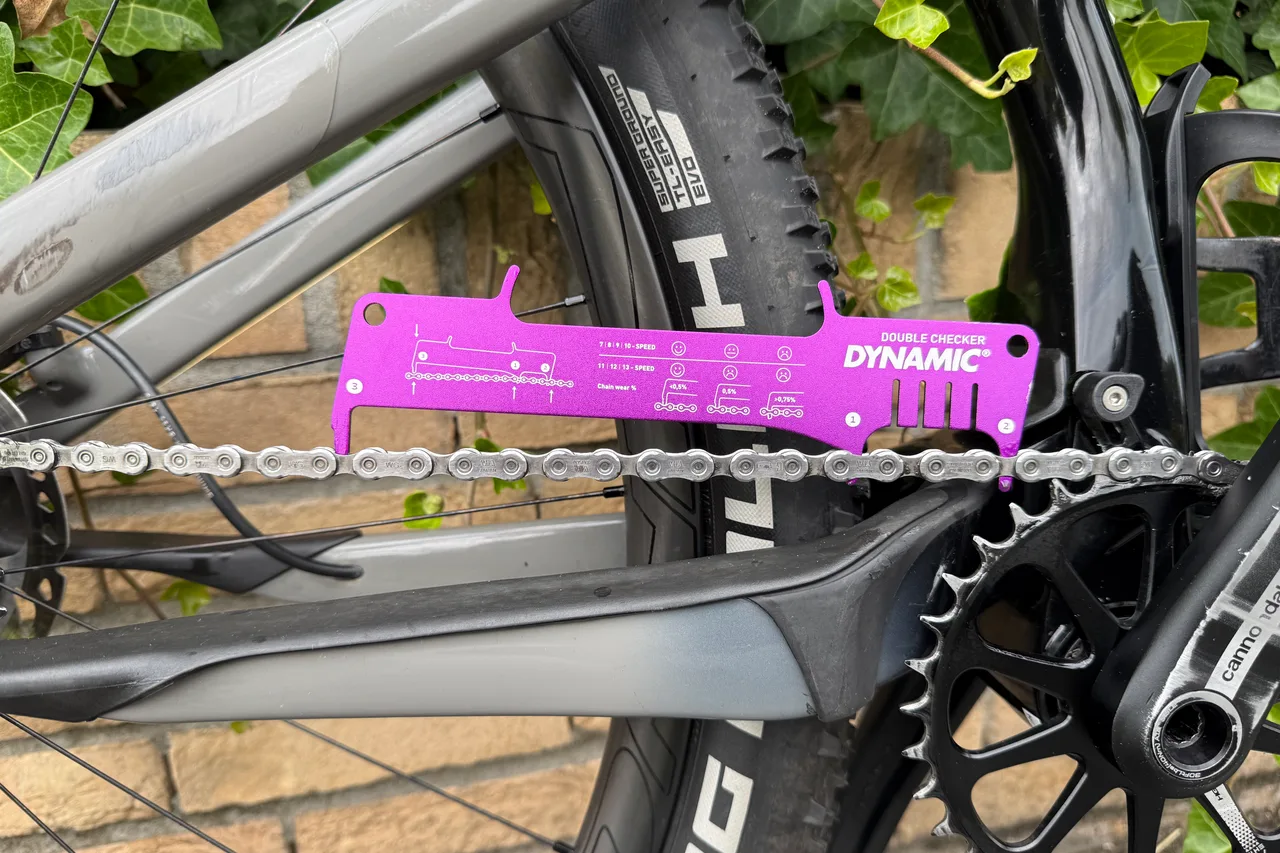
Now I own a proper checker (the purple Dynamic Double Checker in the photo at the top, on my Cannondale's chain) and the app prompts me to use it roughly every 500 km. Most times it reads fine and I ride on. The point is that the check happens before the drivetrain starts complaining, which is the only moment a chain-only replacement is still on the table. I have not had to buy a chain and a cassette together since.
The setup I would actually run
Neither method alone is sufficient. Together they cost about €15 and five minutes a month.
- Set a distance interval on the chain at roughly 2,500 to 3,000 km — deliberately early. Its job is to prompt a check, not to authorise a replacement.
- When it fires, measure. Drop the gauge in. Thirty seconds.
- If it is under the threshold, reset the interval and carry on. You have lost half a minute and gained a real data point.
- If it is at or past the threshold, replace the chain and log the service so the clock restarts from the actual distance.
- Adjust the interval per bike. If your winter bike keeps hitting 0.5% before the prompt, shorten it. That feedback loop is how a predicted interval slowly becomes an accurate one for your conditions.
Step 5 is what makes a predicted interval converge on reality. After two or three chains on the same bike in the same conditions, your interval is no longer a guess. The wider version of this loop — which clock each component wears on, and how to run it across several bikes — is in how to track bike maintenance.
How WatchMy.bike handles it
I will describe this precisely, because the whole point of the post is that the category over-claims.
What it does. Each chain is a component with its own odometer, filled automatically from your Strava rides. You set a service interval in kilometres and get an email when it is reached. When you replace the chain, you record the service and the clock resets from that distance. Every chain you have owned keeps its own history, so you can see that the last three lasted 2,800, 3,100 and 2,400 km — which is a better predictor for your riding than any generic figure.
What it does not do. It does not measure your chain. There is no sensor, no wear estimate derived from power or cadence, no computer-vision check from a photo. The number it shows is distance since installation, and the alert is a threshold you chose.
The one thing it does that a gauge cannot. It remembers. It knows which chain is on which bike, how far each has run, what the previous ones managed, and it tells you before you would otherwise have thought about it. A gauge cannot prompt you, and being prompted is the part riders actually fail at.
Set up these two:
- "Chain wear check" — distance interval, every 2,500 km, framed as a check rather than a replacement
- "Chain replacement" — lifespan target on the component, set from your own history once you have two or three chains logged
FAQ
What are the best apps to monitor chain wear automatically?
No app measures chain wear, so the honest question is which app best predicts it and prompts you to check. Any dedicated maintenance tracker that syncs distance from your rides will do the core job — WatchMy.bike (mine), ProBikeGarage and Componentry all track per-component distance with alerts. What separates them is whether each chain keeps its own history so your intervals improve over time. Pair whichever you pick with a €12 to €25 chain checker, because the app schedules the check and the gauge makes the decision.
Can an app measure chain wear without a tool?
No. Chain wear is physical elongation and measuring it requires contact with the chain. An app can estimate from distance, and that estimate can be wrong by a factor of two depending on weather, lubrication and drivetrain. Any product claiming to measure chain wear from ride data alone is describing a prediction.
Is there a chain wear sensor for bikes?
Not as a consumer product in 2026. There is published research — a 2025 Sports Engineering paper on high-precision in-situ measurement — and granted US patents for chain elongation monitoring devices. Nothing has reached the market. If that changes, automatic chain wear monitoring becomes literally possible rather than a prediction dressed up as one.
At what percentage should I replace my chain?
0.5% elongation on 11- and 12-speed drivetrains, 0.75% on 10-speed and older, where wider chains tolerate more wear. Past those thresholds the chain starts reshaping the cassette teeth and you end up replacing both.
Are digital chain checkers more accurate than the cheap ones?
More precise, not necessarily more accurate. Short two-roller gauges push the rollers apart under spring pressure, so roller wear reads as elongation and inflates the figure — and that applies to digital short gauges too. Testing reported by Velo found the Shimano CN-42, Park Tool CC-3.2 and KMC Digital broadly agreed at around the 0.75% mark. If you want a better measurement, use a longer gauge or a steel ruler across many links rather than a more digital short one.
How many kilometres does a chain last?
Commonly 3,000 to 5,000 km, but the spread is wide enough that the average is nearly useless for an individual rider. Wet and gritty conditions can halve it; a clean waxed chain can beat it comfortably. This is exactly why a distance interval should trigger a measurement rather than a purchase, and why your own logged history beats any published range.
Does WatchMy.bike measure my chain?
No. It tracks distance per chain automatically from Strava, alerts you at an interval you set, and keeps the history of every chain you have fitted. The measurement is still yours to take with a gauge. What it removes is the part riders actually fail at, which is remembering to check.
Questions about chain wear tracking? Reach out at marien@WatchMy.bike.