E-bike Maintenance Tracking: Beyond the Battery

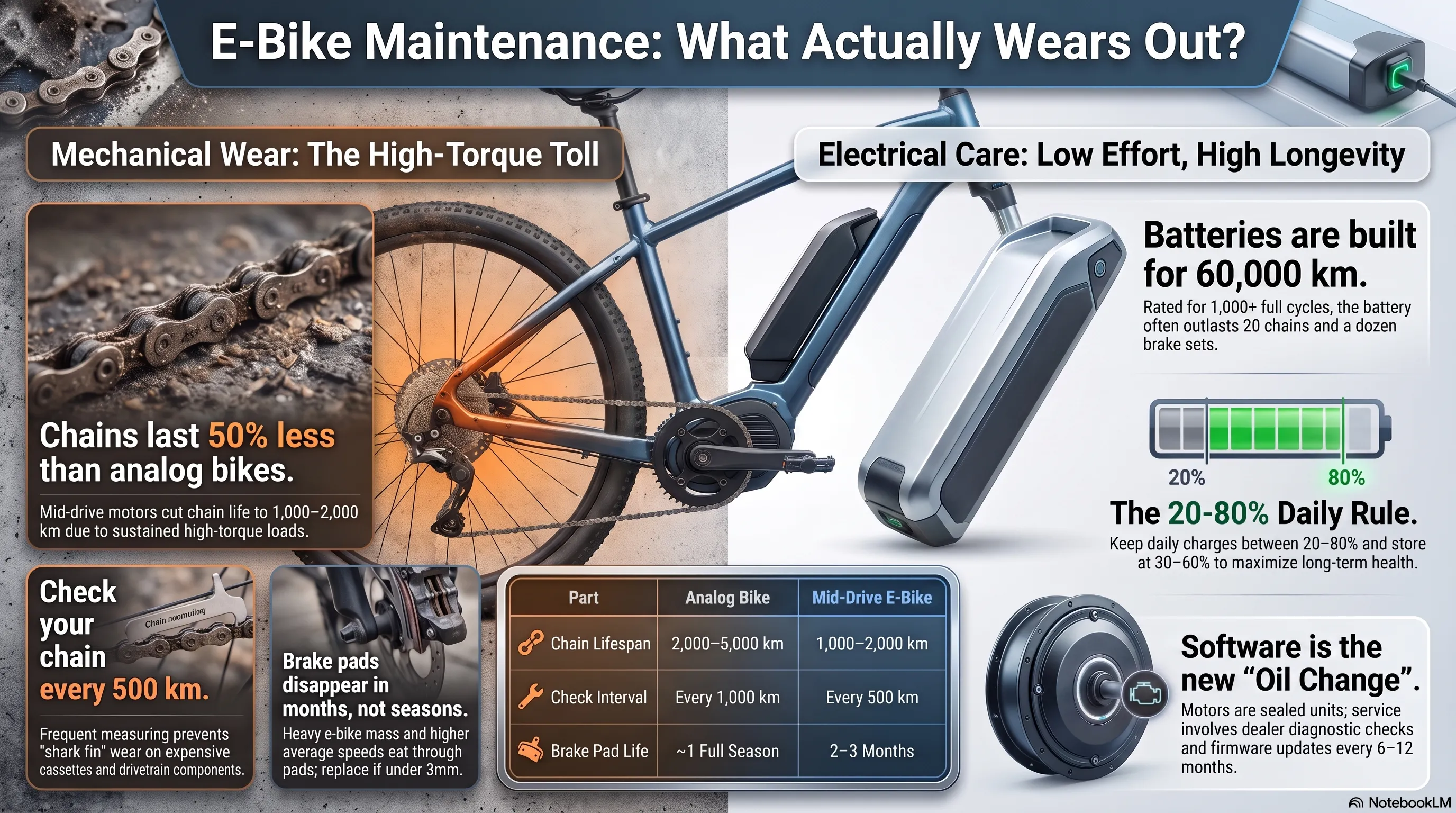
Quick answer: The battery is the part e-bike owners worry about most and the part that fails least — Bosch rates theirs for 1,000+ full charge cycles, up to around 60,000 km of service life. What actually wears out is mechanical: a mid-drive chain lasts 1,000-2,000 km (half to a third of an analog bike), brake pads go noticeably faster under the extra mass and speed, and the motor wants a software/service check every 6-12 months at a dealer. Battery care is three rules: keep it between 20-80% day to day, store it at 30-60% charge, and keep it away from heat.
Ask an e-bike owner about maintenance and they'll tell you about charging habits. Ask their mechanic and you'll hear a different story: cassettes worn to shark fins at 3,000 km, chains stretched past saving, pads down to the backing plate — on bikes whose batteries still report near-full health.
The marketing did this. Every e-bike article, manual, and forum thread orbits the battery, so that's where the attention goes. Meanwhile the motor quietly pushes sustained torque through the same €40 chain a leg-powered bike uses, and nobody's counting the kilometres.
I'll say it: the battery is the most durable consumable on your e-bike. Rated at 1,000+ full cycles, it will outlast 15-20 chains, several cassettes, and a dozen sets of brake pads. If your maintenance attention matches your anxiety, you're servicing the one component that least needs it and ignoring the ones being eaten alive underneath you. The e-bike maintenance problem is mechanical, not electrical.
The Drivetrain: Where the Motor's Torque Actually Goes
A mid-drive motor delivers its assist through the chain. That's sustained, high-torque load — often under shifting, often from a standstill — and it cuts chain life to 1,000-2,000 km, versus 2,000-5,000 km on an analog bike. The full comparison sits in the component lifespan chart.
The knock-on effects follow the same mechanics as any drivetrain, just faster:
| Part | Analog bike | Mid-drive e-bike |
|---|---|---|
| Chain | 2,000-5,000 km | 1,000-2,000 km |
| Chain check interval | every 1,000 km | every 500 km |
| Cassette | 2-3 chains | 2-3 chains — but that's now every ~4,000 km |
| Wear threshold | 0.5% elongation | 0.5% elongation, some brands say replace even sooner |
Two habits blunt the damage: shift before the climb, easing pedal pressure as you do (the motor keeps pushing through your shift, which is how teeth get eaten), and measure chain wear with a checker on a schedule instead of by feel. Chain Maintenance 101 covers the cleaning and lube side — everything there applies, at higher frequency.
Hub-drive riders get a partial pass: no motor torque through the chain. Your drivetrain wears at roughly analog rates; your spokes and rear hub carry the extra load instead.
Brakes: More Mass, More Speed, Same Pads
An e-bike is 8-15 kg heavier than its analog equivalent and spends more of its life at 25+ km/h. Kinetic energy scales with the square of speed — and every bit of it becomes heat in your pads and rotors. Pads that would last a season on a road bike can be gone in a couple of months of e-commuting, which is why most e-bikes ship with bigger rotors and 4-piston calipers in the first place.
The inspection rule doesn't change, only the frequency: check pad thickness monthly, replace under 3 mm including the backing plate. The compound trade-offs are in Brake Pads: When to Replace.
The Battery: Three Rules, Then Stop Worrying
Everything in the official Bosch battery guidance reduces to:
- Day to day: keep charge roughly between 20% and 80%; full charges are for long-ride days, not every night.
- Storage: longer than a few weeks off the bike → store at 30-60% charge, indoors, moderate temperature.
- Heat is the enemy: don't charge immediately after a hot ride, don't leave the battery in a car in summer, don't store it against a radiator in winter.
That's it. Do those three things and the cycle rating takes care of the rest — degradation to 80% capacity after 1,000 full cycles means a 500 Wh battery still delivers real range years in.
The Motor: Sealed, Serviced by Software
Modern drive units (Bosch, Shimano, Brose, Bafang) are sealed. Opening one voids the warranty and rarely ends well — motor care happens at the dealer, and mostly through a diagnostic cable: firmware updates, error-log reads, and bearing checks every 6-12 months or annually with your service.
Between visits, your job is to listen. A motor that develops a new grind, knock, or resistance is telling you about its bearings — book it in while it's a service, not a replacement.
Why Tracking Matters More on an E-bike Than Any Other Bike
Every interval above is shorter, and half of them are invisible from the saddle. An analog rider who skips chain checks wastes a cassette; an e-bike rider doing the same wastes them twice as fast, on a bike where the drivetrain parts are often e-rated and pricier.
E-bikes also make the case for tracking hours alongside kilometres: assist means more elevation and more sustained load per km than the raw distance suggests. Motor service and bearing wear track time-under-load better than odometer readings. Running distance and riding-hour clocks side by side is exactly what a proper maintenance tracking system is for.
FAQ
Do e-bike chains wear out faster than regular bike chains?
Yes, and it isn't close. A mid-drive motor pushes sustained torque through the chain, which cuts its life to 1,000-2,000 km versus 2,000-5,000 km on an analog bike. Check wear every 500 km with a chain checker, and shift before the climb so the motor isn't grinding the teeth mid-gear-change. Hub-drive bikes wear closer to analog rates.
How long does an e-bike battery last?
Bosch rates its batteries for 1,000+ full charge cycles, around 60,000 km, before capacity drops to roughly 80% (Bosch). Kept between 20-80% day to day and stored cool at 30-60% charge, one battery will outlast 15-20 chains. It's the most durable consumable on the bike, not the most fragile.
How often should you service an e-bike motor?
Book a dealer diagnostic every 6-12 months, or bundle it with your annual service. Modern drive units from Bosch, Shimano, Brose, and Bafang are sealed, so a service means firmware updates, error-log reads, and bearing checks over a diagnostic cable, not opening the housing. Between visits, listen for any new grinding or knocking.
Can you pressure wash an e-bike?
No. The motor and battery contacts are sealed against rain and splashes, not against a pressure washer's jet, which can force water past the seals into bearings and electronics. Use a low-pressure hose or a damp cloth, and never aim water straight at the motor or the battery mount.
How WatchMy.Bike Makes This Automatic
E-Bike is a first-class bike type in WatchMy.bike, and intervals run on distance, calendar time, or riding hours — the three units e-bike maintenance actually uses. Strava sync keeps the per-component odometer counting.
Set up these alerts and forget about guessing:
- "Measure chain wear" — recurring every 500 km
- "Motor + software check" — recurring every 12 months
- "Brake pad check" — recurring every 750 km
Set up your first maintenance alert →
Questions about e-bike tracking? Reach out at marien@WatchMy.Bike.