The Essential Road Bike Service Schedule (by Kilometres, Not Guesswork)

•5 min read
Quick answer: Check tires and brakes every ride, lube the chain roughly every 200-300 km, measure chain wear every 1,000 km (replace at 0.5% elongation), inspect brake pads monthly (replace under 3 mm), and book or do a full service once a year — cables, bearings, bar tape, frame inspection. Two items run on a pure calendar regardless of mileage: DOT brake fluid every 12 months and tubeless sealant every 2-6 months.
Somewhere in a drawer you have the service booklet that came with your car, stamped at every interval. Your bike — which you sweat on, ride through rain, and stress at 40 km/h in a group — has nothing. Most riders service it when something creaks, skips, or stops stopping.
The schedules you find online don't help much either. They're written by shops, in shop units: weekly, monthly, yearly. But a "week" means nothing mechanically — a commuter's week is 250 km, a fair-weather rider's week is 40. Wear happens per kilometre, not per calendar page. This page is the road-specific schedule; the general method behind it is in how to track bike maintenance.
I'll say it: the time-based maintenance chart is a proxy for riders who don't know their mileage. Almost everything on a road bike wears by distance; the calendar versions only exist because "every month" is easier to remember than "every 1,000 km." If you know your kilometres — and with a Strava-synced tracker you do — you can throw the weekly/monthly chart away. The exceptions are chemical, not mechanical: brake fluid absorbs moisture and sealant dries out whether you ride or not. Those two genuinely run on a calendar.
Every Ride: The 30-Second Check
No tools, no stand. Before rolling out:
- Tires — pinch or gauge check; look for cuts and embedded flint.
- Brakes — squeeze both levers; firm bite point, no drag on the rotor or rim.
- Headline noises — lift the bike a few centimetres and drop it. New rattles get investigated, not ignored. If something already creaks, start with Where Does That Creak Come From?
- Thru-axles / quick releases — snug, especially after transport.
Every 200-300 km: Chain Lube (Sooner in Rain)
Wipe the chain with a rag, re-lube, wipe the excess. That's it — over-lubing attracts more grit than under-lubing sheds. One wet ride resets the counter to zero: water strips lube in a single outing.
The full clean-lube-or-wax decision is covered in Chain Maintenance 101.
Every 1,000 km: Measure, Don't Feel
This is the interval that saves real money, and it takes five minutes:
| Check | Threshold | If it fails |
|---|---|---|
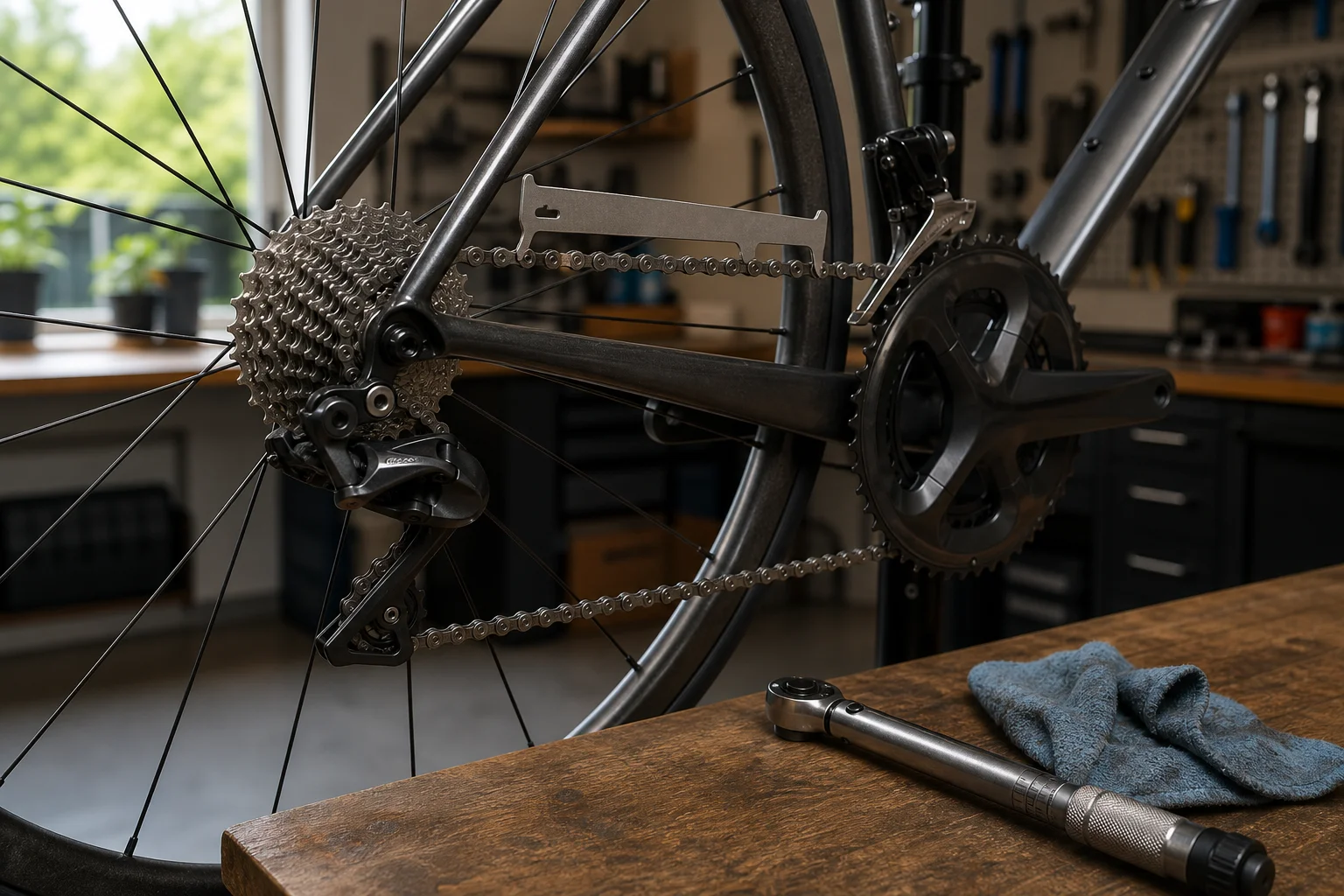
| Chain wear (use a checker) | 0.5% elongation on 11/12-speed | Replace the chain (~€30-50) before it eats the cassette |
| Rear tire profile | Squared-off crown, wear dimples gone | Rear is done around 3,000-6,000 km — see When to Replace Your Bike Tires |
| Shifting crispness | Hesitation a barrel-adjuster turn won't fix | Cables are stretching or contaminated |
| Bolt check | Stem, bars, seatpost at torque spec | Re-torque with a torque wrench, not feel |
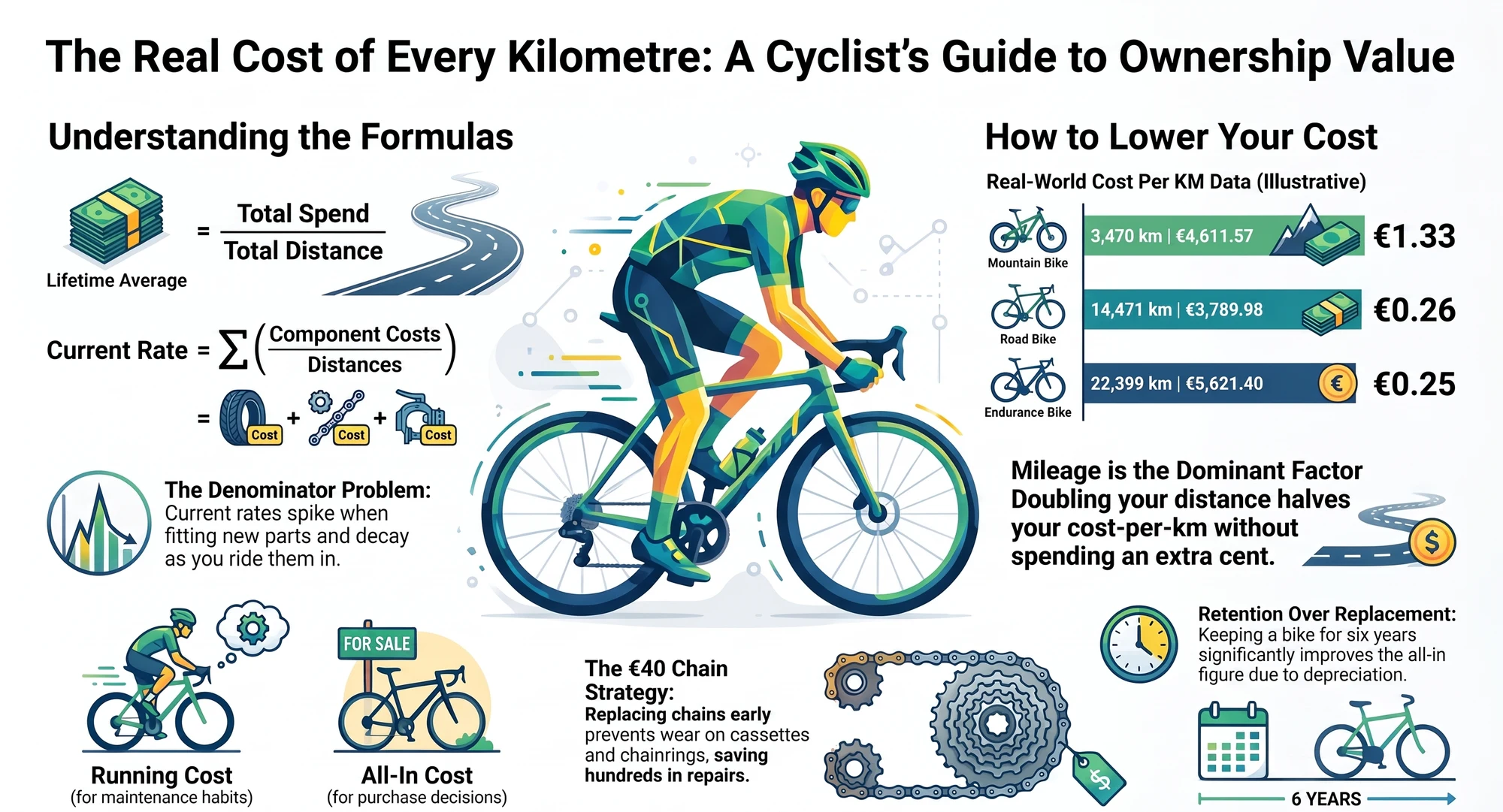
The chain measurement is the single highest-leverage habit in road maintenance. Replace on time and a cassette survives 2-3 chains; run one chain long and it takes the cassette and eventually the chainrings with it. The full economics are in the component lifespan chart.
Monthly-ish (or Every 1,500 km): Pads and Drivetrain Deep Clean
- Brake pads — pull the wheel, eyeball the pads. Under 3 mm including backing plate means shopping time. Ranges and compound differences are in Brake Pads: When to Replace.
- Drivetrain deep clean — cassette, jockey wheels, chainrings. A clean drivetrain is quieter, faster, and wears measurably slower.
- Sealant check (tubeless) — shake the wheel and listen for liquid. Silence means the sealant dried out and your puncture protection is gone. Top up every 2-6 months depending on climate.
Every 12 Months: The Calendar Items and the Annual Service
Once a year, mileage regardless:
- Brake fluid — DOT fluid wants a yearly bleed because it absorbs moisture through the hose walls; mineral oil systems stretch to two years. Why the chemistries differ: Brake Fluid 101.
- Cables and housing — sluggish shifting that indexing won't fix; typically 2-3 years, rear first, sooner for wet-weather riders.
- Bearings — bottom bracket, hubs, headset. None of them have a visible wear indicator; all of them announce failure late. Spin, wiggle, listen.
- Bar tape — hardened, torn, or shiny tape is a grip hazard, not a cosmetic issue. Replacing it is a 30-minute job.
- Frame inspection — clean the bike fully and look: cracks at welds and junctions, paint bubbling, anything new.
High-mileage riders (5,000+ km/year) or wet-climate riders: treat this as a twice-a-year list. Conditions halve intervals — that rule is universal. Ride off-road? It's the same schedule, halved for gravel.
How WatchMy.Bike Makes This Automatic
Every interval above is a distance or a time span — exactly what WatchMy.bike tracks per component. Strava sync keeps the odometer running; the alerts fire before the deadline instead of after the damage.
Set up these alerts and forget about guessing:
- "Measure chain wear" — recurring every 1,000 km
- "Bleed brakes" — recurring every 12 months
- "Drivetrain deep clean + pad check" — recurring every 1,500 km
Set up your first maintenance alert →
Questions about your service schedule? Reach out at marien@WatchMy.Bike.