Gravel Bike Maintenance Schedule: The Road Schedule, Halved

•5 min read
Quick answer: Run road-bike maintenance at half the interval: chain wear check every 500 km (dust and grit are the accelerant), tubeless sealant every 2-3 months (it's your primary flat protection out there), drivetrain deep clean after every properly dirty ride, and bearings — bottom bracket, headset lower race, hubs — inspected yearly at minimum, sooner if you ride wet. Gravel tires last 2,000-5,000 km. And rinse with a bucket or low-pressure hose: a pressure washer forces water past bearing seals faster than any rainstorm.
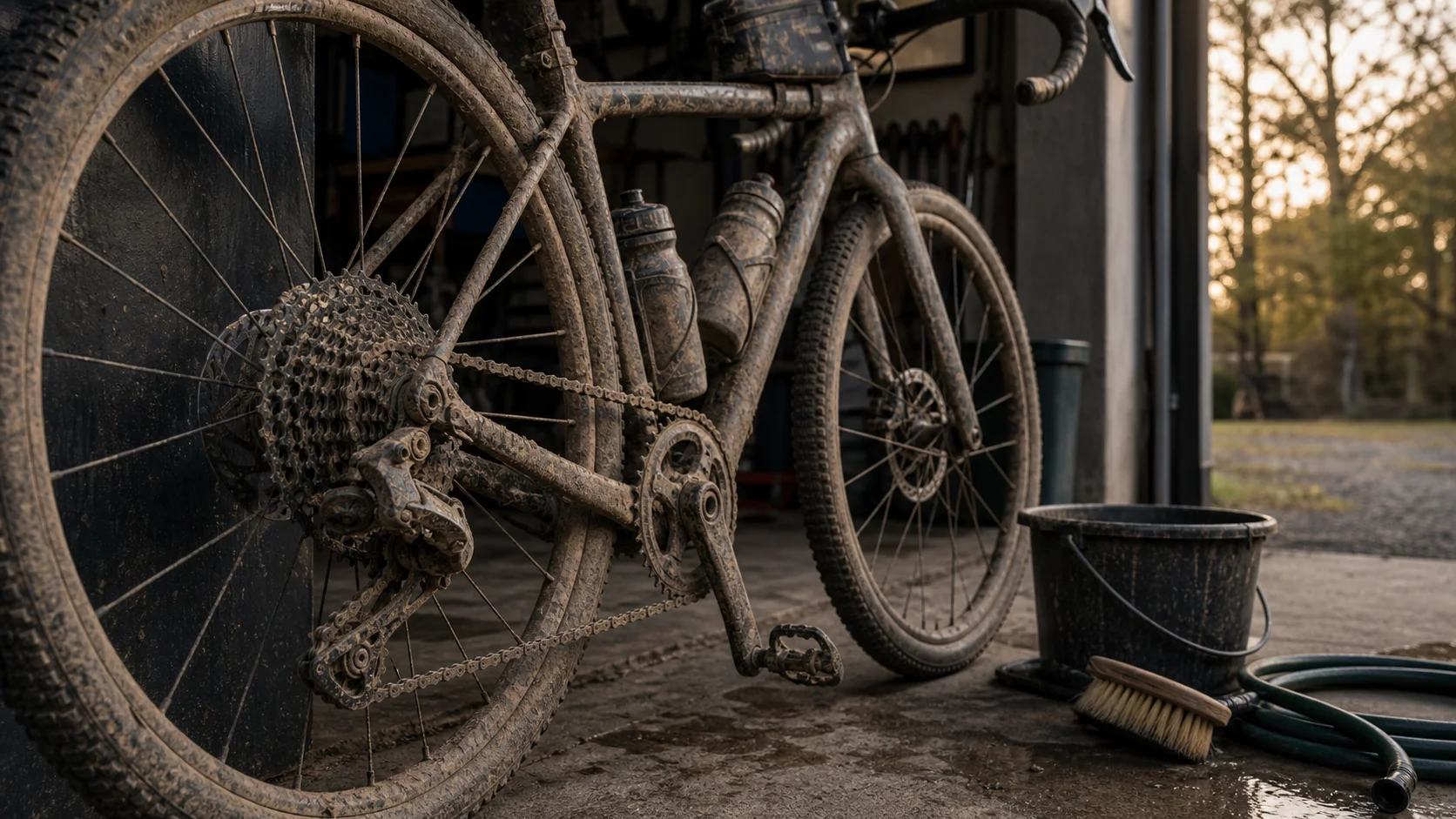
The ride that kills a gravel bike isn't the epic — it's the ordinary Sunday loop with twenty minutes of fine dust, a water crossing, and a hose-down afterwards. Dust is an abrasive, water is a carrier, and the combination works its way into every interface on the bike while everything still looks fine from the saddle.
Search for "gravel bike maintenance" and you get the same generic shop chart as road bikes, re-badged with a gravel photo. That's because there's no secret gravel-specific procedure — the parts are the same parts. What changes is the multiplier, applied on top of the standard tracking method.
The gravel-maintenance myth: your gravel bike doesn't need different maintenance. It needs the same maintenance more often. The honest schedule is one rule — take the road intervals and apply a conditions multiplier — and one warning: more gravel bearings are killed by post-ride pressure washing than by the mud itself. High-pressure water drives grit past seals that shrug off rain all day.
The Multiplier Table
Start from the road service schedule and adjust:
| Your typical riding | Interval multiplier | Example: chain check |
|---|---|---|
| Dry hardpack, fair weather | ~0.75× road | every 750 km |
| Mixed dust and occasional rain | ~0.5× road | every 500 km |
| Regular mud, sand, or winter riding | ~0.3× road | every 300 km |
The same multiplier hits everything downstream: pads, cables, bearings, tires. If you ride more than 100 km a week in real gravel conditions, halving is the floor, not the ceiling.
After Every Dirty Ride: The Ten-Minute Reset
- Rinse low-pressure — bucket and brush, or a hose on shower setting. Keep any pressure washer a metre away from hubs, bottom bracket, headset, and pivots.
- Dry and re-lube the chain — a wet, gritty chain left overnight starts wearing before breakfast. This is where chain wax earns its reputation: grit doesn't stick to a waxed chain the way it embeds in wet lube. The full comparison is in Chain Maintenance 101.
- Check tires — sidewall cuts from embedded flint and thorn stubs. Gravel casings take hits road tires never see.
Every 500 km: Chain and Contact Points
Measure chain wear with a checker — replace at 0.5% elongation on 11/12-speed. On gravel this interval matters twice as much as on the road: grit paste between the rollers is a grinding compound, and a worn chain destroys cassettes just as enthusiastically off-road. The chains-per-cassette economics are in the component lifespan chart.
While the checker is out: spin the jockey wheels (mud can round them off in a season where road riders get 10,000+ km) and check pad thickness — gritty descents eat pads far faster than the resin/sintered ranges suggest.
Every 2-3 Months: Sealant, Whether You Rode or Not
On the road, dried-out sealant is an inconvenience. On gravel, it's your primary flat protection, and it dries on a calendar, not an odometer — 2-6 months by brand and climate, so gravel riders should work to the front of that range. Shake the wheel; silence means top-up time.
Pressure matters as much as sealant: gravel is where a few PSI changes both grip and pinch-flat resistance. The tire pressure calculator covers the numbers.
Yearly (Sooner If You Ride Wet): Bearings and the Hidden Interfaces
Gravel's vibration and contamination load lands on the parts you can't see:
- Headset lower bearing — takes rider weight plus everything the front wheel throws at it. A creak after a wet season is the lower race asking for grease.
- Bottom bracket — the 5,000-16,000 km road range compresses hard with water crossings and dust. The service-or-replace call is in Bottom Brackets: When to Service, When to Replace.
- Hubs and freehub — gritty spin or a rough freehub buzz means the grease is gone.
- Seatpost and stem interfaces — pull, clean, re-grease (or re-paste for carbon). Half of all mystery creaks live here.
How WatchMy.Bike Makes This Automatic
Halved intervals are exactly the kind of thing memory fumbles — "did I check the chain at 500 or was that 900 km ago?" WatchMy.bike tracks distance per component via Strava sync, so the multiplier becomes a number you set once instead of arithmetic you redo every ride.
Set up these alerts and forget about guessing:
- "Measure chain wear" — recurring every 500 km
- "Top up tubeless sealant" — recurring every 3 months
- "Bearing check (BB, headset, hubs)" — recurring every 12 months
Set up your first maintenance alert →
Questions about your gravel setup? Reach out at marien@WatchMy.Bike.