Autumn Mud and Your MTB Drivetrain: What Wet Sand Does to a Chain, Cassette and Derailleur

•13 min read
Quick answer: Wet, sandy mud wears your mountain bike drivetrain faster than dry dirt because the water carries the grit into places dust can't reach: between the chain's rollers and pins, into the derailleur pulleys and around the chainring teeth. Most of the damage happens after the ride, not on it. Within an hour of getting home, rinse the bike at low pressure, run the chain through a dry rag, re-lube with one drop per link and wipe off the excess. Through autumn, measure chain wear every 500 km (replace at 0.5% elongation) and check brake pads after every muddy ride, because wet grit can strip resin pads in under 100 km.
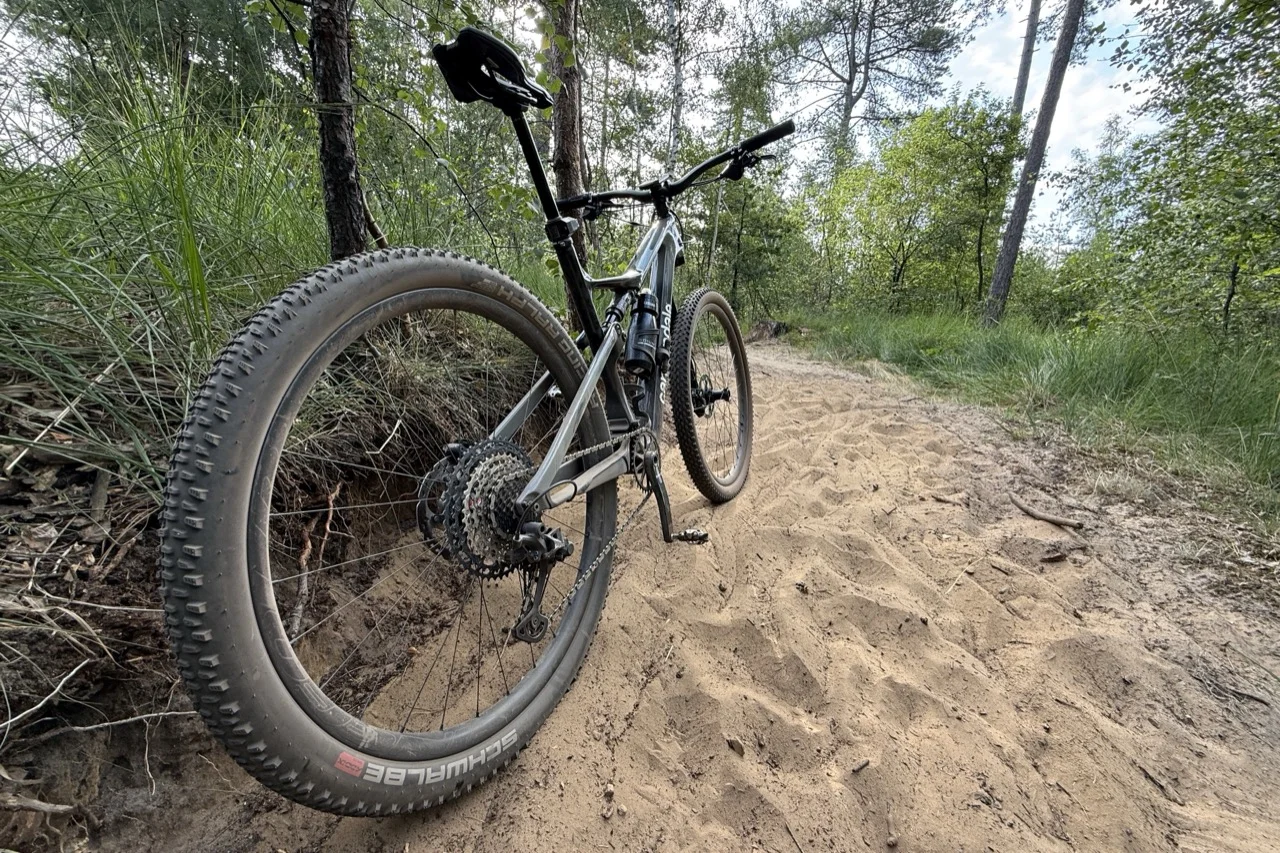
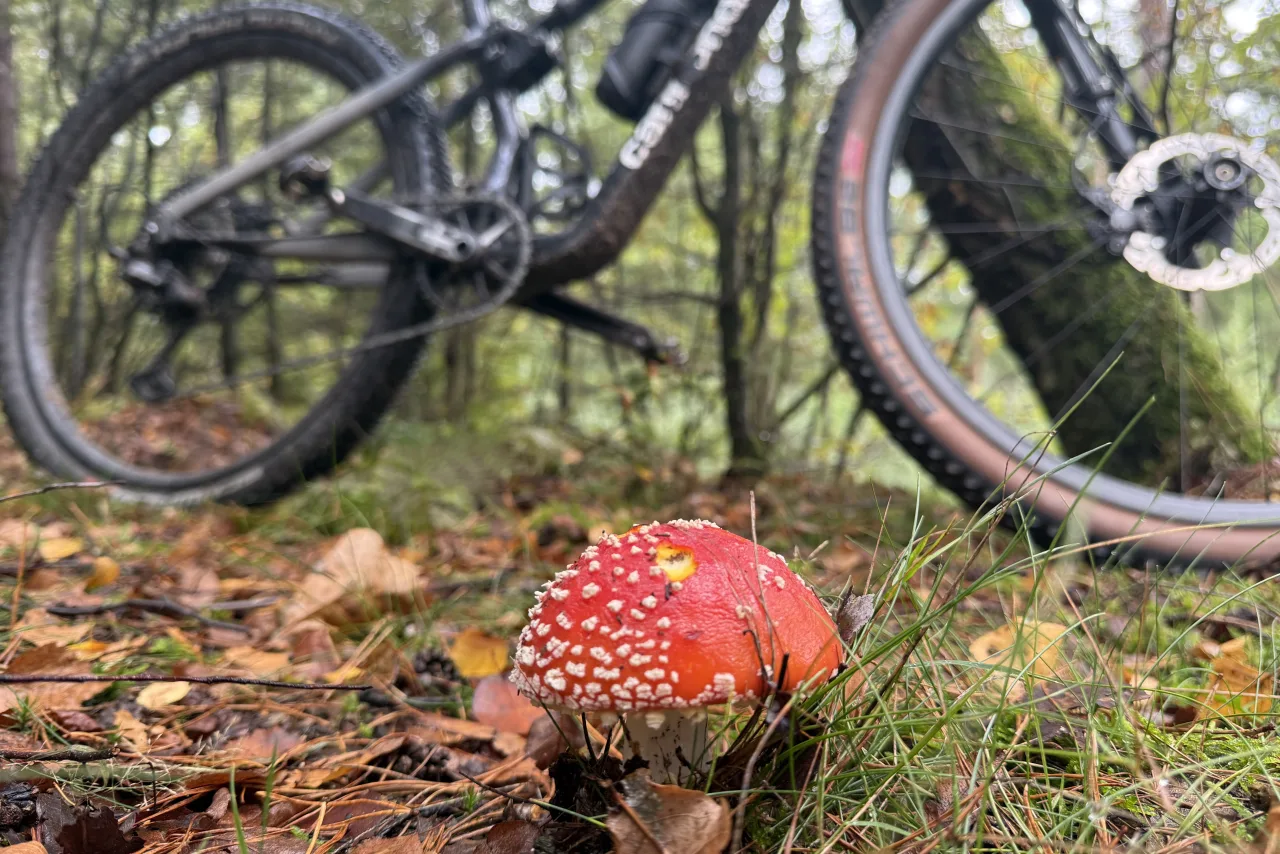
On 1 October I rode my Cannondale Scalpel around Den Treek on the Utrechtse Heuvelrug: 47 km, 2 hours 19 minutes, 203 m of climbing, in the rain at 18 °C and 94% humidity. The trails were soft, the leaves were down, and there was a fly agaric growing next to the spot where I stopped for a breather. That's the photo at the top of this post.
Nothing broke and nothing skipped. What I noticed was the sound: from about the first half hour, every pedal stroke came with a gritty crunch of sand being crushed between the chain and the teeth. That noise is the wear happening.
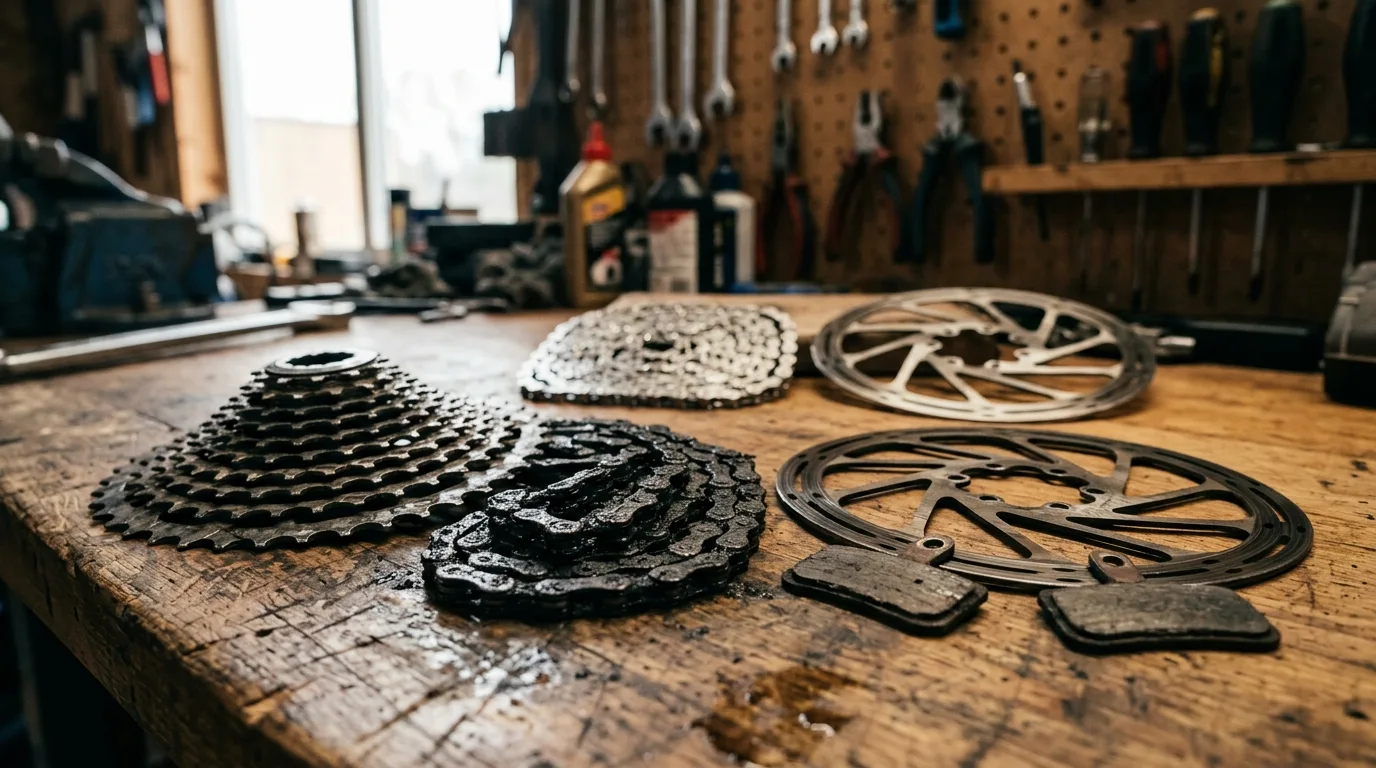
Then I got home and looked at the drivetrain. Below are the photos I took that afternoon, before I touched anything. If you ride on sandy soil in autumn, your bike probably looks like this after every ride from now until March. What you do in the next hour matters more than the ride did.
Why Is Wet Sand Worse Than Dust or Clay Mud?
In summer I wrote that a dry, dusty summer is harder on your bike than a wet winter, because dust hides inside the drivetrain while mud is visible and washes off. After this ride I'd add a caveat: that only holds for mud you clean off the same day. Sandy mud is that same abrasive, but now water carries it into the chain.
Three kinds of dirt, three different problems:
| Dirt | What it does | Where it ends up |
|---|---|---|
| Dry dust | Sticks to lube and forms a grinding paste | Chain surface, fork seals |
| Clay mud | Heavy, packs and clogs, but holds little sharp grit | Tyre clearance, cassette gaps, frame |
| Wet sand | Water carries quartz grit deep into moving parts, then it dries in place | Inside chain rollers, pulley bearings, between chainring teeth |
The forest trails here are mostly sand under a layer of leaves and needles. Wet, that turns into a grey-brown paste which coated everything below the hub line on my bike within the first half hour.
What the Mud Did, Component by Component
Cassette: mud packed between the cogs
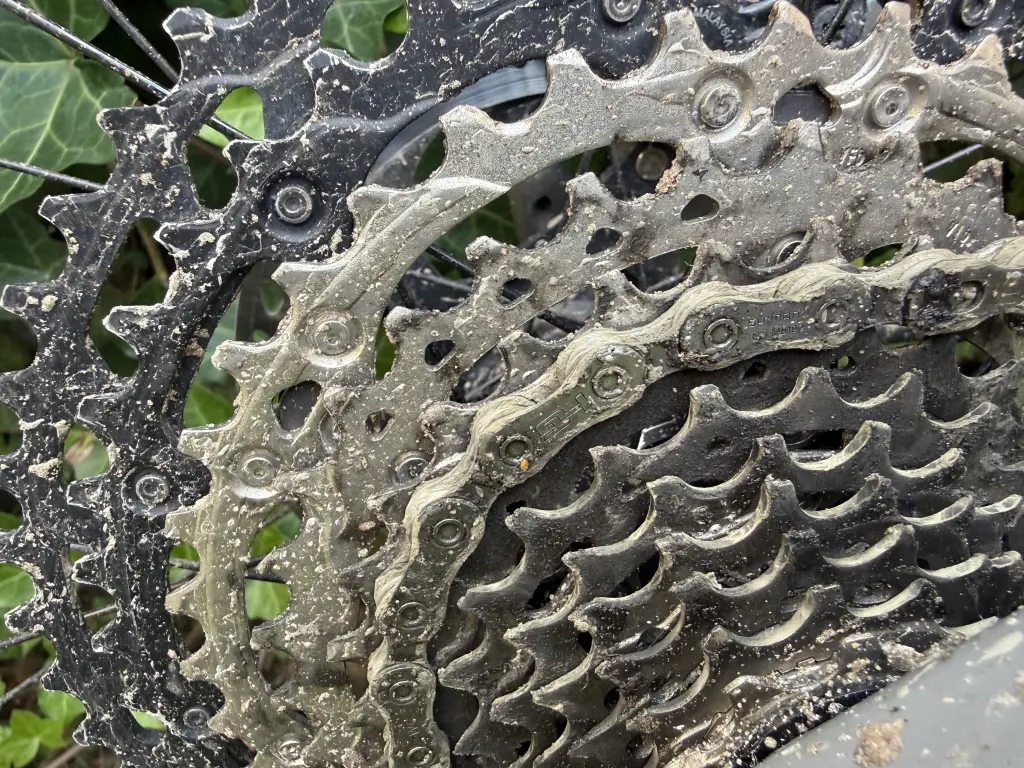
Shimano XT CS-M8100 cassette, about 3,040 km in. Sand packs into the valleys between the teeth and the spaces between the cogs.
When mud fills the gap between two cogs, the chain can't sit fully down on the teeth. That's where autumn ghost shifting comes from: the chain rides high, skips under load and jumps to the next cog without you touching the shifter. The cassette itself isn't damaged by one ride. A chain grinding sand into the tooth faces ride after ride is what wears it.
Chain: grit inside the rollers
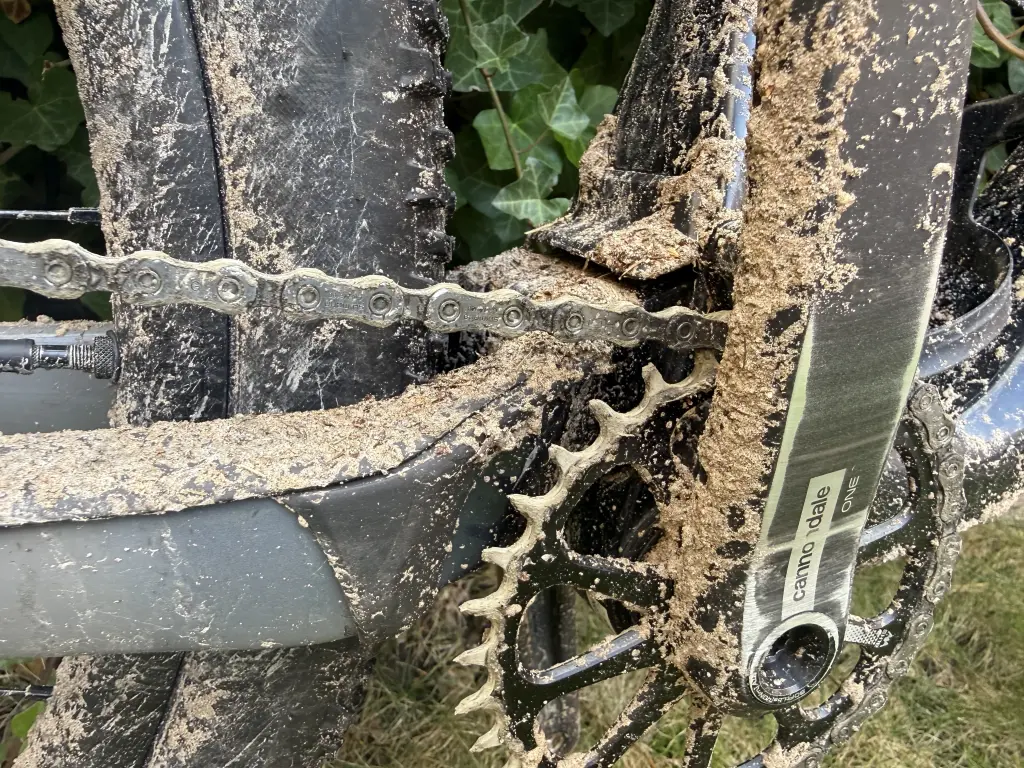
Every link has a film of wet sand on it, and some of it is already inside the rollers.
This is the expensive part. A chain doesn't wear by its plates getting thinner. It wears at the pins and bushings, where each link pivots, and that wear makes the chain longer. Wet sand gets into exactly that gap. Dust mostly sits on the surface; water carries the grit inside. Leave it there and every pedal stroke on the next ride works it in further. My chain maintenance guide covers why chain wear speeds up as it progresses, and gritty conditions push that curve forward.
After this ride I finally put the chain checker on it, and it dropped in past 0.75%. That's the "replace immediately" line, well beyond the 0.5% where I should have swapped it. The chain, a Shimano CN-M6100, had done 2,610 km. In WatchMy.bike I'd set its expected lifespan to the default 3,200 km, so as far as the app was concerned it still had 600 km left. I did have a reminder: my 150 km "Clean and Lube" interval says check chain in its description. But a check buried inside a cleaning job is easy to skip, and I kept skipping it.
That's on me, not the chain. The XT chain before it was retired at 2,248 km, so my own history already said that on this bike, in this sand, a chain lasts closer to 2,000–2,500 km than 3,200. A lifespan is an estimate. The chain checker is the measurement, and I'd stopped doing the measuring.
What I'm changing: each new chain gets a lower expected lifespan (around 2,000 km, based on my last two chains), so the wear warning shows up before the chain is finished, not after. And I'm adding a separate "check chain wear" service interval every 500 km, which is the reminder to actually put the checker on it. The lifespan tells me roughly when. The checker tells me for sure. Both chains go into WatchMy.bike as separate components, so each keeps its own kilometres while I swap them.
I still need to check whether the cassette survived. A chain run past 0.75% can reshape the cassette teeth, and if a new chain skips on the cogs I use most, the cassette goes too.
Rear derailleur: pulleys packed with mud
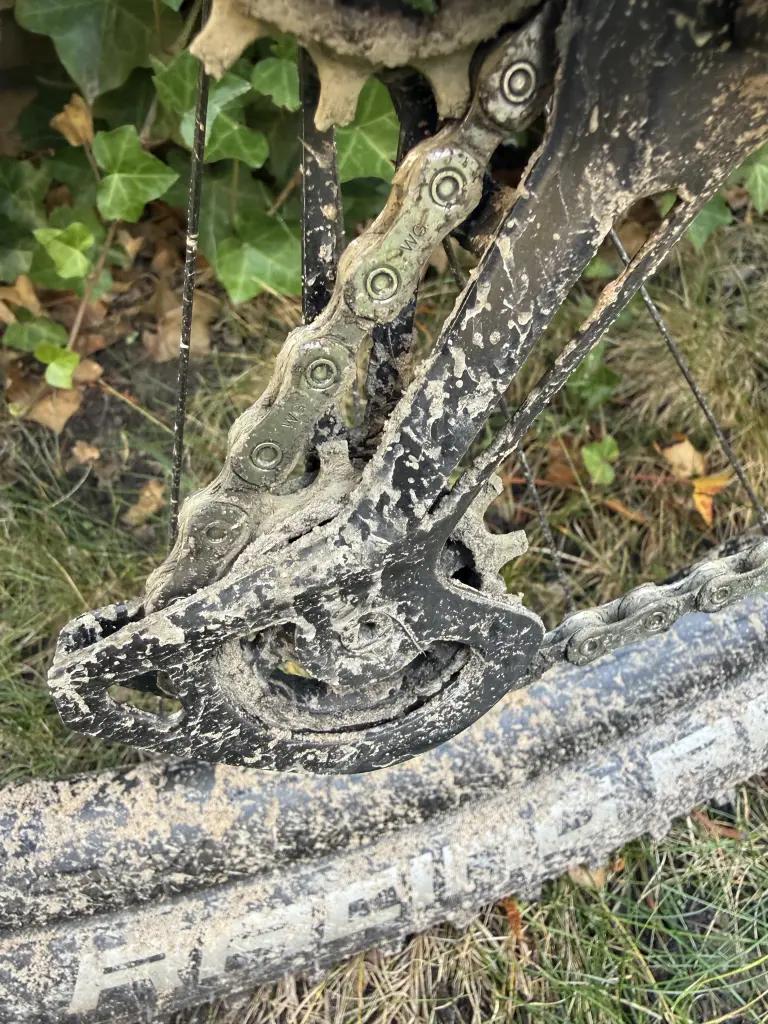
The XT M8100 derailleur cage. The lower pulley is barely visible under the mud.
A pulley wheel turns faster than any other part of the drivetrain. When mud packs around it, it drags, and the bearing seals sit in grit until you clean them. Pulley bearings are cheap, but a gritty, notchy pulley costs you watts and wears the chain on every revolution.
Chainring and crank: sand on the teeth
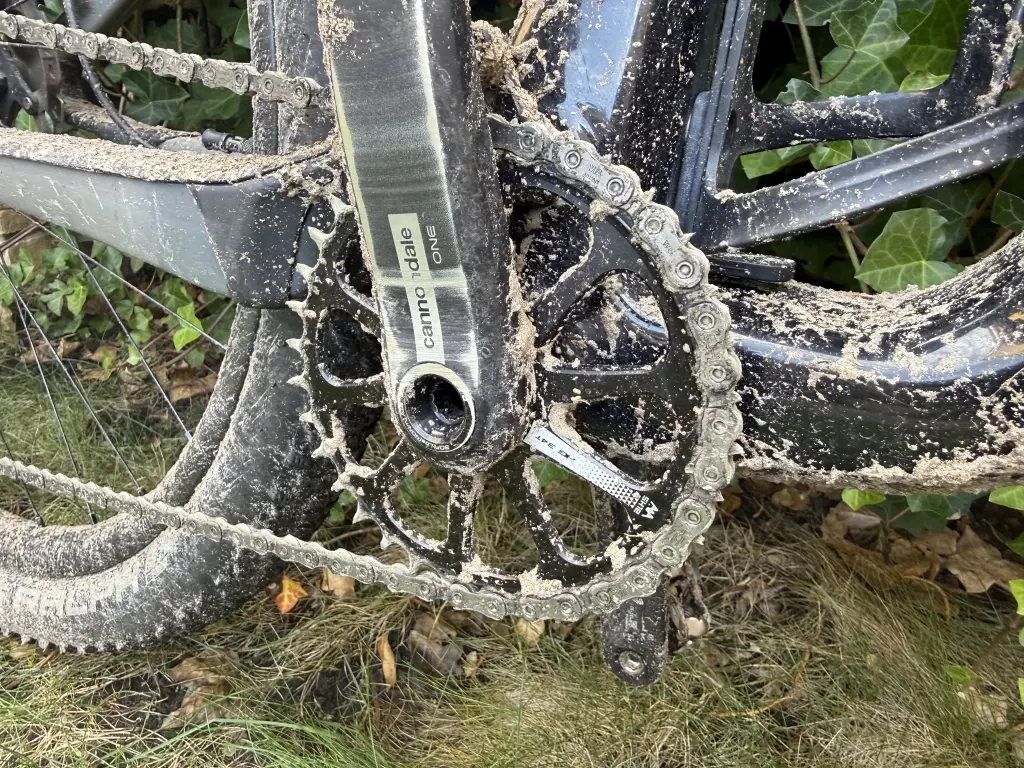
Cannondale One crank with a 34T SpideRing. Sand sits between the narrow-wide teeth, right where the chain has to seat.
On a 1x drivetrain the chainring teeth are tall, narrow-wide profiles that hold the chain on without a front derailleur. Pack sand between them and the chain can't seat properly, which is when you get chain suck (the chain doesn't release at the bottom of the ring and gets dragged up into the frame) or a dropped chain on a rough section. Chainrings outlast several chains, but sand is what turns their teeth into shark fins.
I'll say it: the ride doesn't wear out your drivetrain in autumn. The evening after it does. Wet sand that dries on overnight, or a chain rinsed with water and left to stand, does more damage than the mud you rode through.
The Hour After the Ride: What I Do Now
After the Den Treek ride I washed the bike thoroughly as soon as I got home, and only then put the chain checker on it. Do it in that order: a gauge on a gritty chain doesn't read properly.
You don't need a workshop. You need a bucket or a hose, a brush, a rag and lube. Park Tool's bike washing guide describes the same steps.
- Rinse at low pressure, top down. A garden hose with a wide spray, or a bucket and a sponge. Park Tool's advice: "use only low pressure with a wide spray."
- Brush the drivetrain while it's still wet. Cassette gaps, pulley wheels and chainring teeth first, because that's where the sand packs. Wet sand comes off easily. Once it dries, it sets hard.
- Dry the chain. Run it backwards through a clean, dry rag. Water left on a chain overnight starts surface rust on the pins and plates, and it pulls the grit further in as it dries.
- Re-lube. One drop per link, spin the cranks, then wipe off the excess. Lube left on the outside of the chain only catches the next ride's sand.
- Wipe the stanchions and seals. Same reason as in summer: grit on the stanchion gets dragged past the wiper seal on the next compression.
Don't use a pressure washer. A high-pressure jet "is liable to disperse grease from bearings whilst forcing dirt into critical components," as Ribble put it to road.cc. In autumn that means sand in your hubs, bottom bracket and pivot bearings.
Which Chain Lube for Autumn Mud?
Wet weather is what "wet lube" exists for. It's thicker, stays on through rain and keeps water off the steel. The catch is that it also holds on to sand, which is why the wipe-off step matters more than the brand.
| Lube | In wet, sandy autumn conditions |
|---|---|
| Wet lube | Survives rain and long rides; collects grit, so wipe the outside dry after applying |
| Dry lube | Stays cleaner but washes off within one wet ride; re-apply after every ride |
| Hot wax | Cleanest chain, but water strips it quickly; plan to re-wax more often through winter |
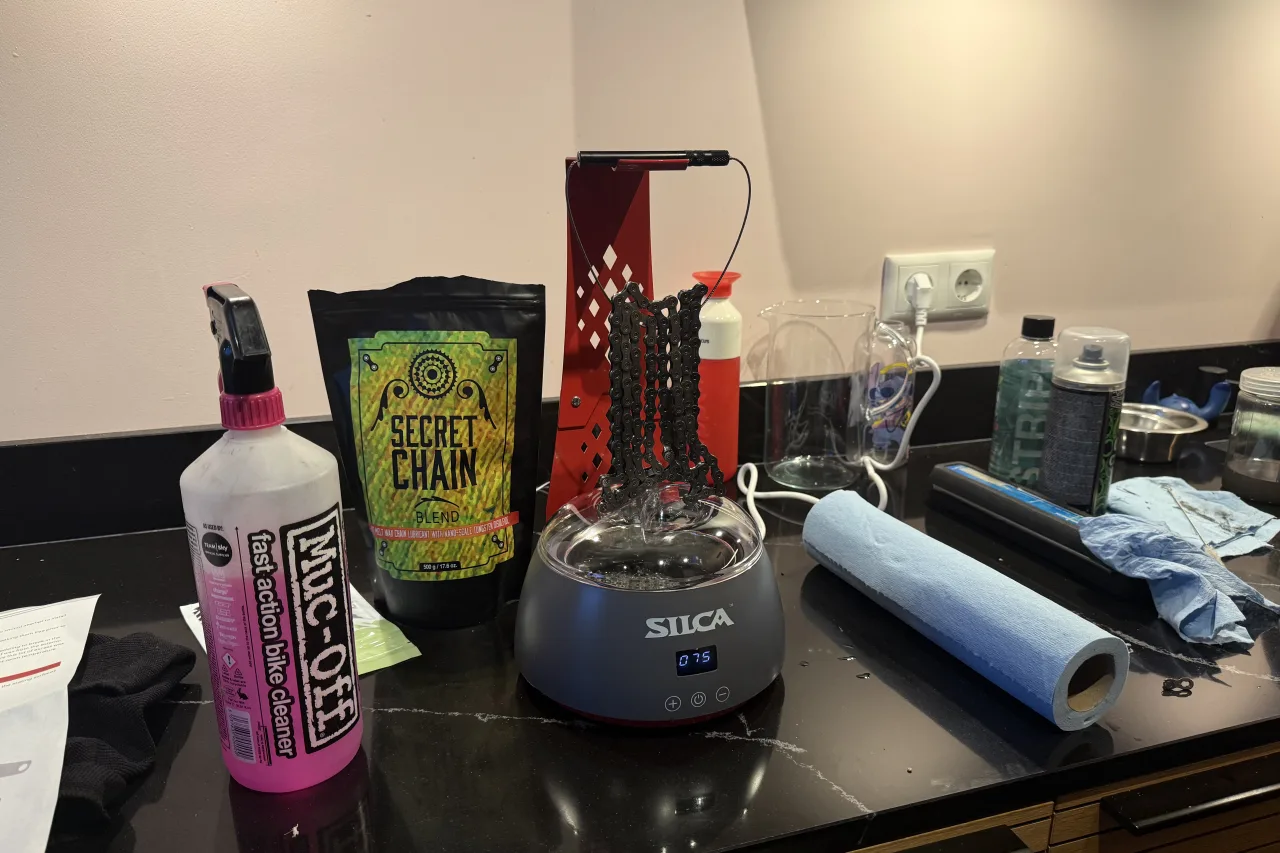
I've switched my road and indoor bikes to wax (here's why I went from sceptic to trying it), and in that post I left the Scalpel undecided, because wet mud is where wax has the weakest case. This ride decided it, just not the way the textbook says. I bought two Shimano CN-M8100 XT chains (€33.95 each) and a spare SM-CN910-12 quick link (€10.95), €78.85 in total at my local shop. It's the same XT chain the Scalpel ran before the Deore one. Both get waxed, and they rotate on the Scalpel this winter; the first went on the bike today. When one comes home soaked and sandy, it comes off, gets cleaned and re-waxed, and the other goes on. It's an experiment: if wax can't keep up with Heuvelrug mud, I'll say so in the waxing post.
What Autumn Does to Your Service Intervals
Wet, gritty riding shortens the life of everything that moves. These are the checks I tighten from October to March, using the numbers from my MTB service schedule:
| Component | Dry-season habit | Autumn and winter |
|---|---|---|
| Chain clean + lube | Every 100–150 km | After every muddy ride |
| Chain wear | Measure every 500 km | Every 500 km, replace at 0.5% without waiting |
| Brake pads | Check every 500 km | Check after every wet, gritty ride |
| Derailleur pulleys | At each chain swap | Spin them by hand at each clean; replace when notchy |
| Fork lowers | RockShox: every 50 hours | Bottom of the range, wipe the stanchions after every ride |
Brake pads deserve their own warning. Riders have worn a fresh set of resin pads down to the backing plate in under 100 km of wet, gritty riding (more in my brake pad guide). My Scalpel runs Shimano L05A resin pads, now at about 845 km. After a ride like this I check them before the next one.
FAQ
Should I clean my mountain bike after every muddy ride?
Yes, at least the drivetrain. A full wash can wait, but the chain, cassette, pulleys and chainring should be rinsed, dried and re-lubed the same day. Sandy mud that dries on is much harder to remove and keeps wearing the chain on the next ride.
Can I use a pressure washer on my MTB?
Better not. A high-pressure jet pushes water and grit past bearing seals in hubs, the bottom bracket, headset and suspension pivots, and strips the grease inside. Use a hose on low pressure with a wide spray, or a bucket and brush.
Why does my chain skip after a muddy ride?
Usually because mud is packed between the cassette cogs or chainring teeth, so the chain can't seat. Clean it out first. If it still skips on a clean drivetrain, measure the chain: a chain past 0.5% elongation skips on a worn cassette, especially on the cogs you use most.
Does mud wear out a chain faster?
Yes. Wet sand gets into the pins and bushings where chain wear happens. As my chain guide covers, a mountain bike chain lasts roughly 1,500–3,000 km, and riding in wet grit without cleaning pushes you toward the short end of that range. My last Scalpel chain was past 0.75% at 2,610 km.
Wet lube or dry lube for autumn?
Wet lube, applied to a clean, dry chain and then wiped off on the outside. Dry lube washes off within a single wet ride. Wax works if you're prepared to re-wax more often than in summer.
How WatchMy.Bike Makes This Automatic
Autumn advice is easy to agree with in October and forget by December. WatchMy.bike counts the kilometres and riding hours from your Strava activities, so the reminder arrives when the bike has actually done the work, not on a calendar date.
It only works if the numbers match your riding. My chain went past 0.75% because I left its expected lifespan at the 3,200 km default and had no reminder to measure it. Two settings would have caught it:
Set these up before the wet season:
- A realistic chain lifespan — set the chain's expected lifespan from your own history, not the default. If your last chains were replaced at 2,000–2,500 km, set around 2,000 km so the wear warning arrives early.
- "Measure chain wear" — a distance interval, every 500 km. This is the reminder to get the chain checker out. The lifespan estimates; the checker measures.
- "Check brake pads" — a distance interval, every 250 km through the wet months (lengthen it again in spring).
- "Fork lower-leg service" — a riding-time interval, 50 hours, so a big muddy week brings the date forward automatically.
Log the service when it's done and the counter starts again from zero. New to alerts? The maintenance-alerts starter guide walks through the first six.
Set up your first maintenance alert →
Questions about keeping a drivetrain alive through a muddy autumn? Reach out at marien@WatchMy.Bike.