The Mountain Bike Service Schedule (in Hours and Kilometres, Not Seasons)
•8 min read
Quick answer: A mountain bike wears by ride hours and conditions, not by the calendar. Check tyres, brakes and bolts every ride; clean and lube the chain after every dirty ride and at least every 100-150 km; measure chain wear every 500 km (replace at 0.5% elongation); do a fork lower-leg service every 50 hours (RockShox); a full damper and spring service every 100-200 hours (RockShox) or 125 hours or yearly (Fox); bleed DOT brakes every 12 months; and pull the pivot bearings once a year. For a typical trail rider, 50 hours is roughly 600-750 km. Road bike? That schedule is here. Gravel? Here.
The rear shock on a mountain bike does something a road bike part never does: it works hardest when the odometer moves slowest. A two-hour technical ride might show 22 km on Strava. The chain saw 22 km. The fork saw two hours of compressions, and it does not care about the distance at all.
That is why the road and gravel schedules on this site do not transfer to a mountain bike service schedule. Half the bike still wears by kilometre — chain, cassette, pads, tyres. The other half wears by the hour — fork, shock, dropper post, pivot bearings. A schedule that only counts one of the two misses half the bike.
I'll say it: the "spring tune-up" is the least useful maintenance interval in mountain biking. A rider who does 40 hours of trail between April and October has a fork that is overdue by August, and a rider who does 15 hours a year is paying for a service the fork did not need. The manufacturers publish the service interval in hours for a reason. Use it, and the seasonal checklist becomes irrelevant.
Every Ride: The Two-Minute Check
MTB rides start further from home and end further from a shop than road rides. The pre-ride check earns its time back the first time it catches something.
- Tyre pressure — gauge, not thumb. Loose ground wants lower pressure than you think; the reasoning is in the dry-conditions post.
- Sealant — spin the wheel and listen for sloshing. Silence means the sealant dried and you are riding a tubeless tyre with no puncture protection.
- Brakes — firm bite, no rub, no spongy travel. SRAM's line is 3 mm or less including the backing plate; Shimano's is 0.5 mm of pad material. Either way, replace before the ride, not after.
- Suspension sag and rebound — a quick bounce. If the fork tops out with a clunk or sits low, something changed.
- Bolts — stem, bars, axles, pivot hardware. Trail vibration loosens things a road bike never sees.
After Every Dirty Ride: Clean the Drivetrain, Not the Bearings
Mud and dust are abrasives. A chain ridden dirty wears itself and everything it touches. Rinse with a bucket or a low-pressure hose, wipe the chain, re-lube. In dust, wax or a dry lube; wet lube in dust turns to grinding paste.
Never aim a pressure washer at hubs, pivots, the bottom bracket or the fork seals. It pushes water past seals that were designed for rain, not for a jet. This one habit shortens bearing life more than any trail does.
Every 25 Hours (or ~300-400 km): Look, Wipe, Measure
| Check | What you are looking for | If it fails |
|---|---|---|
| Fork stanchions and shock shaft | Dust ring above the seal, oil weep, scratches | Wipe the seals, note it. Persistent weep = service now. |
| Chain wear | 0.5% elongation on a checker | Replace the chain before it takes the cassette. |
| Brake pads | 3 mm or less incl. backing plate (SRAM) | Replace. Sintered pads for wet, resin for quiet dry riding. |
| Dropper post | Sag under load, slow return, hissing | Air pressure first, service second. |
| Tyre knobs | Rounded centre knobs, torn side knobs | Replace on condition, not distance. Schwalbe says no useful mileage figure exists for MTB tyres; riding style dominates. |
Chain wear on a mountain bike is a 500 km check, not the 1,000 km the road schedule uses. Grit halves the interval. Same rule as gravel.
Every 50 Hours: The Lower-Leg Service
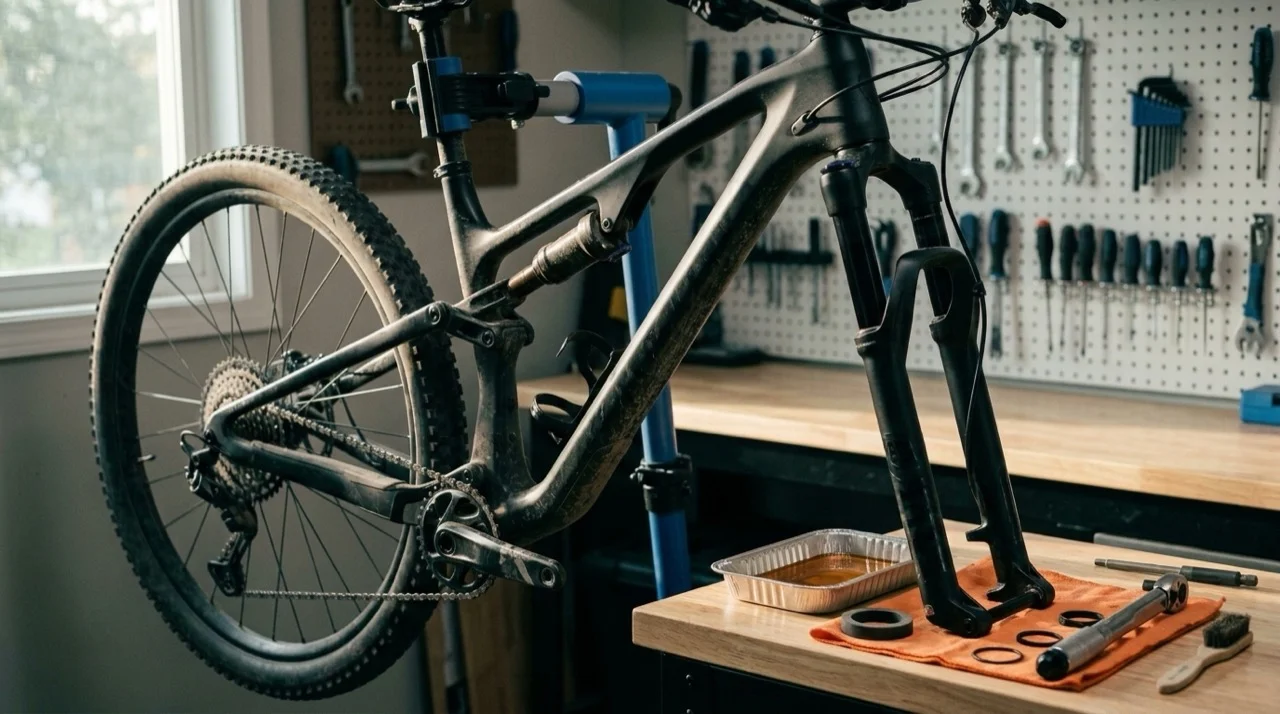
This is the fork service mountain bikers skip most, because nothing feels wrong yet. RockShox specifies a lower-leg service every 50 hours on every current fork from Judy to ZEB, and calls it a maximum: drop the lowers, clean the foam rings, fresh bath oil, new dust seals if the old ones are hard. Fox now publishes a single number, a full service every 125 hours or yearly, whichever comes first; its older manuals asked for air-sleeve maintenance every 30 hours. Both brands say to service sooner in mud, dust, bike-park laps or on an e-MTB. Neither gives a factor, so treat the published number as a ceiling.
Fifty hours of trail riding for most people is 600-750 km at a typical 12-15 km/h moving average. For a weekend rider that is a season. For someone riding three evenings a week it is two months.
At the same 50-hour mark: check rear-shock air-can sag and pressure, and add air to the dropper if it has been slow.
Every 100-200 Hours or 12 Months: The Big Service
Once a year at minimum, sooner if the hours arrive first:
- Fork damper service — RockShox 200 hours on most forks from the last decade, 100 hours on older models; Fox 125 hours or yearly. This is a shop or a specialist job for most riders.
- Rear shock full service — damper oil, seals, nitrogen charge on shocks that have it. Shop job.
- Dropper rebuild — depends on the generation. A current Reverb AXS or Stealth C1 wants a service at 200 hours and a full rebuild at 600; older Reverbs come due sooner. The 2025 Fox Transfer wants a collar clean every 25 hours and a full service at 300.
- Pivot bearings — pull the shock, cycle the linkage by hand. Notchy or gritty means new bearings. Nobody publishes an interval; a year of wet riding is enough to ruin a set.
- Brake bleed — SRAM says DOT fluid at least once a year and mineral oil every two years. Shimano gives no calendar interval, only to replace the oil when it is badly discoloured. The chemistry is in Brake Fluid 101.
- Hub and bottom bracket bearings — spin, wiggle, listen. Replace, don't regrease, if they are sealed cartridges.
- Frame and rim inspection — clean the bike fully and look at every weld and every spoke hole.
The Hours-to-Kilometres Conversion
Suspension makers count hours because that is what the damper feels. Strava counts kilometres and moving time. If you know your own average trail speed, the two units become one:
| Your moving average | 50 hours equals | 100 hours equals | 200 hours equals |
|---|---|---|---|
| 10 km/h (technical, steep) | 500 km | 1,000 km | 2,000 km |
| 12 km/h (typical trail) | 600 km | 1,200 km | 2,400 km |
| 15 km/h (flowing, XC) | 750 km | 1,500 km | 3,000 km |
Or skip the conversion entirely and track the hours directly. Strava records moving time per ride; a tracker that reads it can run a riding-hours interval without you ever doing the maths.
My own Scalpel is the case for counting hours. I bought it second-hand on buycycle, and nobody could tell me how many hours the suspension had done since its last service. So I rode it for a while and then had it serviced anyway, because an unknown number is the same as an overdue one. That service was on 10 July 2025. Since then I have ridden it for 79 hours, which leaves 21 hours until the next 100-hour service. I don't have to remember any of that. I'll get a notification when it's due.
That is the whole point of this schedule. You don't need a better memory. You need a counter that starts on the day of the last service and a reminder before it runs out.
How WatchMy.Bike Makes This Automatic
Every interval on this page is a distance, a time span, or a number of riding hours. WatchMy.bike tracks all three per component, fed by Strava. The fork gets a riding-hours alert. The chain gets a distance alert. The brake fluid gets a calendar alert. You get told before the interval, not after the creak.
Set up these alerts and forget about guessing:
- "Fork lower-leg service" — recurring every 50 riding hours
- "Measure chain wear" — recurring every 500 km
- "Bleed brakes + pivot bearing check" — recurring every 12 months
Set up your first maintenance alert →
Questions about your MTB service schedule? Reach out at marien@WatchMy.Bike.